

Mesmerizing plasma loops on the sun photo of the day for Sept. 3, 2026
[post_content]
Disclaimer: This article has been automatically aggregated from
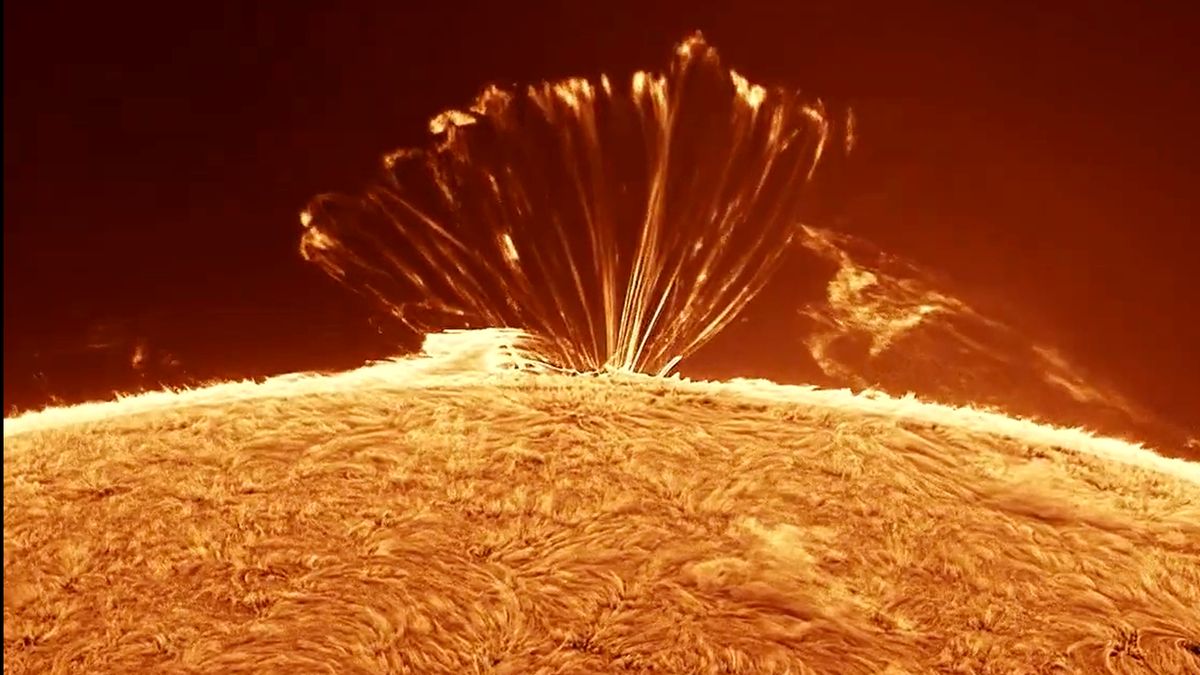
A spectacular series of glowing plasma loops arcs above the sun in this remarkable view captured from an astrophotographer’s backyard.
What is it?
This image is a still from a high-resolution timelapse captured by astrophotographer Mark Johnston from Scottsdale, Arizona on Aug. 21, 2026.
The footage shows a coronal loop arcade — a series of arching loops of hot plasma shaped by the sun’s magnetic field — extending high above the solar limb, or apparent edge of the sun.
Johnston recorded the scene for more than two hours, from 7:56 a.m. to 10:12 a.m. local time. His footage reveals the movement of plasma within the loops, including ‘coronal rain’ as material cools and falls back towards the lower solar atmosphere along magnetic field lines.
The sequence was captured using a TEC160FL refractor equipped with specialized hydrogen-alpha (H-alpha) solar imaging equipment, which helps reveal structures in the sun’s atmosphere that would otherwise be very difficult to see.
Why is it incredible?
Coronal loop arcades like this one are a rare sight, but Johnston was particularly lucky to catch this one almost side-on at the edge of the sun, revealing the dramatic arching shape in exquisite detail.
“To see one AND catch it right on the limb AND have it happen on a clear day when I’m home and able to catch it was a real treat,” Johnston told Space.com in an email.
Lucky for us, Johnston keeps a close eye on our star. The first thing he does each morning is check real-time imagery from NASA’s Solar Dynamics Observatory (SDO) to see what the sun is up to.
“One day I saw this and leapt out of bed and dashed to get set up to capture it,” Johnston said.
And this isn’t the first spectacular solar show Johnston has captured from his backyard. Back in June, he imaged a colossal ‘Godzilla’ plasma cloud seemingly stalking the edge of the sun, complete with streams of coronal rains cascading back towards the solar surface.
for informational purposes only. We do not claim ownership, accuracy, or liability for the content provided. All rights belong to the original publisher.