

Stunning Roman-era mosaic discovered in Turkey features ‘Emerald’ the cat and ‘Ocean’ the dog
[post_content]
Disclaimer: This article has been automatically aggregated from
Nearly two millennia ago, a wealthy Roman commissioned an intricate, multicolored floor mosaic that depicted two beloved household animals: a cat named Emerald and a dog named Ocean. The mosaic was a key feature of a villa, which archaeologists recently unearthed from beneath the ancient city of Adramytteion on Turkey’s Aegean coast.
Within the Roman villa, which has been dated to the late second to third centuries A.D., archaeologists discovered three halls surrounding a central atrium. In one room, which likely functioned as the villa’s main reception hall, archaeologists found a colorful mosaic with 15 separate panels depicting living and mythological creatures.
In a study forthcoming in the Journal of Mosaic Research, archaeologist Hüseyin Özgen, head of the Adramytteion research team at Mimar Sinan Fine Arts University, wrote that the 15 panels are centered around what appears to be a depiction of Medusa, while the named cat and dog may preserve the memory of household creatures.
Latest Videos FromLive Science
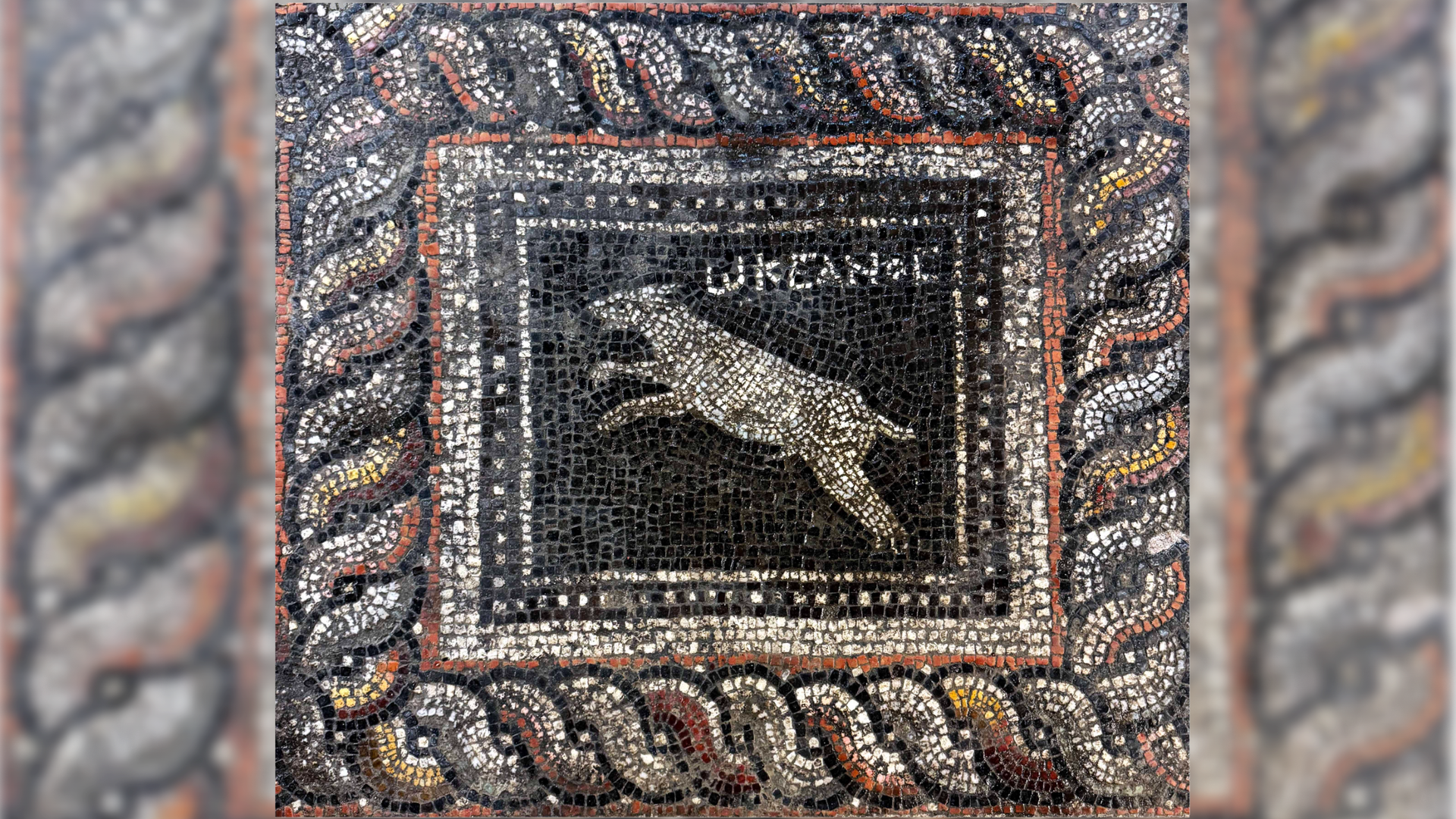
Another panel of the mosaic depicts a dog named Ocean.
(Image credit: H. M. Özgen/Adramytteion Research Archive)
Özgen began excavating at Adramytteion in 2012, but he and his team discovered the Roman villa only recently and excavated it in 2025 and early 2026. In the Roman period, Adramytteion was a provincial capital within Asia Minor and a prime trading spot due to its location at the head of a gulf on the Aegean Sea. The impressive villa included three mosaic-paved halls, a number of secondary rooms, and a network of pipes and drains that may have connected to a latrine.
Visitors approaching from the courtyard of the villa would have been greeted by the largest, most elaborate mosaic in the residence, according to Özgen. Located in the middle of the room, the mosaic measures about 16.4 by 11.8 feet (5 by 3.6 meters) and contains 15 panels arranged in three rows. Most of the panels depict birds, fish and felines, but two mythologically inspired panels include a gorgon (possibly Medusa) and a winged horse (possibly Pegasus). Ancient artists used white, black, red, orange, yellow, pink, burgundy, blue, turquoise and green tiles to create the intricate design.
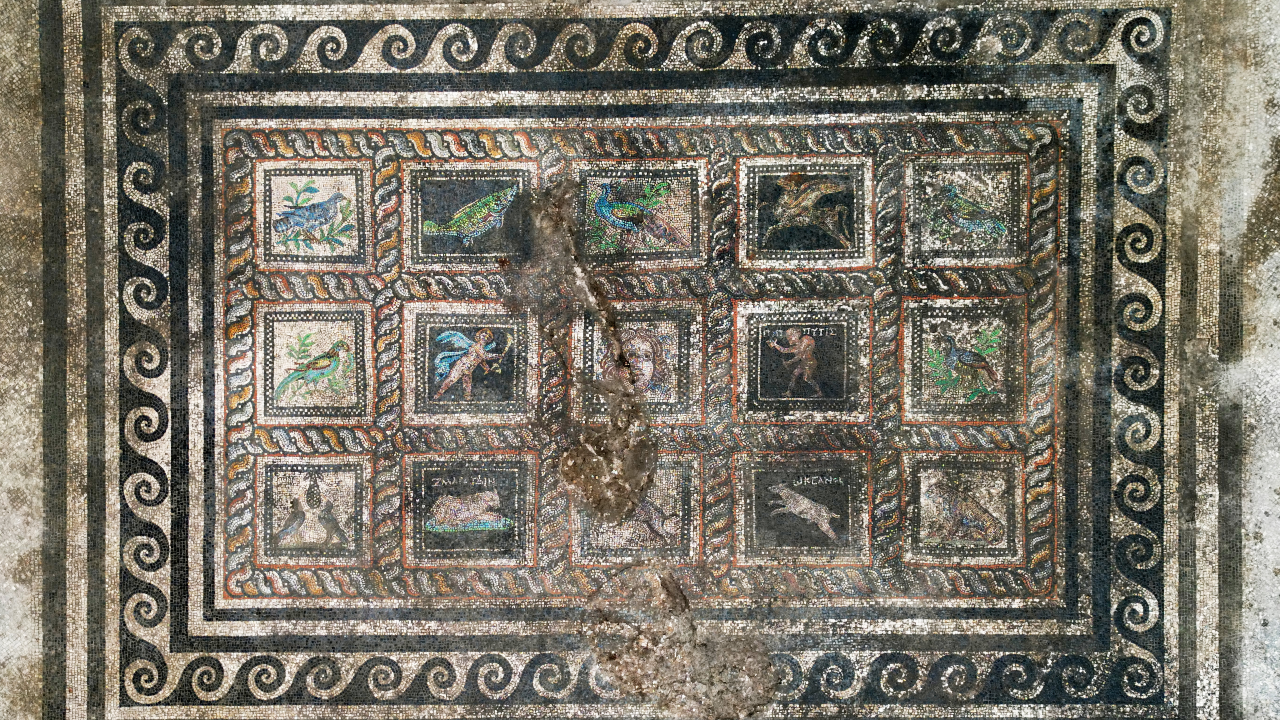
Archaeologists discovered the colorful floor mosaic in a Roman-era residence at Adramytteion, an archaeological site in Turkey.
(Image credit: H. M. Özgen/Adramytteion Research Archive)
Only two of the animals depicted in the mosaic are named. As someone entered the room, the first mosaic panel they would have seen to their left was a pale cat seated on a blue-green cushion, Özgen wrote in the study. Above the cat are the Greek letters ΖΜΑΡΑΓΔΙΝ (Zmaragdin), meaning emerald. The relaxed cat sitting on a cushion suggests that Emerald may have been a pet rather than a stray.
One possible explanation for Emerald’s name may be a link to the desert of Roman Egypt, where emeralds were mined in antiquity; the villa owner may have been a merchant with North African connections.
On the right side as someone entered the room was a mosaic panel depicting a running or leaping dog. This animal is labeled with the Greek letters ΩΚΕΑΝΟΣ (Okeanos), meaning ocean. Adramytteion was a harbor city, so Ocean’s name may have been bestowed due to his surroundings, according to Özgen.
Emerald and Ocean were likely familiar to the villa’s residents, even if they weren’t specifically pets, Özgen wrote, and their depictions in the mosaic may have functioned as familiar signs of ownership and household identity.
Research at Adramytteion by Özgen and the project team is ongoing.
Özgen, H.M. (2026). Mosaic programmes and architectural transformation in an atrium-centred Roman-period residence at Adramytteion: The north, east and south halls. Journal of Mosaic Research 19.
From Augustus to Nero, see how much you know about ancient Rome’s famous leaders with our Roman emperor quiz!
for informational purposes only. We do not claim ownership, accuracy, or liability for the content provided. All rights belong to the original publisher.
Share this:
- Share on Facebook (Opens in new window) Facebook
- Share on X (Opens in new window) X
- Print (Opens in new window) Print
- Share on LinkedIn (Opens in new window) LinkedIn
- Share on Threads (Opens in new window) Threads
- Share on Mastodon (Opens in new window) Mastodon
- Share on Bluesky (Opens in new window) Bluesky
- Share on Telegram (Opens in new window) Telegram
- Share on Pinterest (Opens in new window) Pinterest
- Share on WhatsApp (Opens in new window) WhatsApp
- Share on Nextdoor (Opens in new window) Nextdoor
- Email a link to a friend (Opens in new window) Email
- Share on Tumblr (Opens in new window) Tumblr
- Share on Reddit (Opens in new window) Reddit