Disclaimer: This article has been automatically aggregated from
An enormous, ongoing cosmic “fart” is causing a mysterious zombie star to flare up repeatedly, shining bright pulses of X-rays toward Earth, a new study reveals. The unprecedented observations shed light on how some of the universe’s most extreme objects interact with one another.
Around 13,000 light-years from Earth lies an unusual binary star system, known as BP Crucis. It contains a blue hypergiant star roughly 60 times larger than the sun, dubbed Wray 977, alongside a neutron star — the undead and ultradense remains of a star that exploded via a supernova — that astronomers have labeled GX 301-2.
This stellar “zombie,” which contains the same mass as our home star packed into an object roughly 12 miles (20 kilometers) across, is a type of neutron star called a pulsar, which has an extremely powerful magnetic field and spins rapidly. This means it constantly shoots out a wobbling beam of powerful electromagnetic radiation, including X-rays, into the cosmos at regular intervals. When this beam aligns with Earth — approximately every 11 minutes, in the case of GX 301-2 — our planet’s telescopes detect a flash.
However, unlike most other known pulsars, GX 301-2 also emits frequent X-ray flares (separate from the regular beams), which cause it to shine much brighter at repeated intervals. And, until now, researchers were unsure why.
In the new study, published Sept. 18 in the journal Science Advances, researchers used the X-ray Imaging and Spectroscopy Mission (XRISM) — a space telescope jointly operated by NASA and the Japan Aerospace Exploration Agency — to take a closer look at BP Crucis. In doing so, they discovered that the neutron star flared up every time it passed through a giant plume of “stellar wind plasma” shooting out of its hypergiant partner.
New observations reveal that GX 301-2 flares up when it passes through the stellar wind plume ejected by Wray 77. This animation shows how the plasma swirls around and interacts with the wobbling neutron star.
(Image credit: NASA’s Goddard Space Flight Center/Conceptual Image Laboratory)
This is the first time that researchers have ever detected this type of stellar material interacting with a neutron star, or with any other similar stellar remnant, opening the door to studying similar systems in the future.
“We’ve never before seen clear indications of wind plasma falling onto a compact object,” study first author Roi Rahin, a researcher at the University of Maryland, Baltimore County (UMBC) and NASA’s Goddard Space Flight Center, said in a statement. “We can now test our understanding of these processes in much greater detail.”
Get the world’s most fascinating discoveries delivered straight to your inbox.
Whoever smelt it … explodes?
All stars that actively burn via nuclear fusion release streams of radiation and charged particles known as stellar wind. The sun emits such a stream, known as the solar wind, which can trigger vibrant aurora displays near Earth’s poles.
However, massive stars like Wray 977 blow stellar winds that are much more extreme. The blue hypergiant emits a single giant plume of concentrated ionized gas, or plasma, that spills out at around 335,000 mph (540,000 km/h). (Scientists think the stellar wind is likely sculpted into a single, concentrated plume due to the gravitational effects of the star’s ultradense neighbor.)
GX 301-2 circles Wray 977 every 41.5 days and experiences its X-ray flares when it reaches its closest and farthest points from its partner, with the strongest flares occurring at its closest point. As a result, researchers had long suspected that the flares occurred when the neutron star passed through the stellar wind plume. However, they had no way of proving this without more evidence.
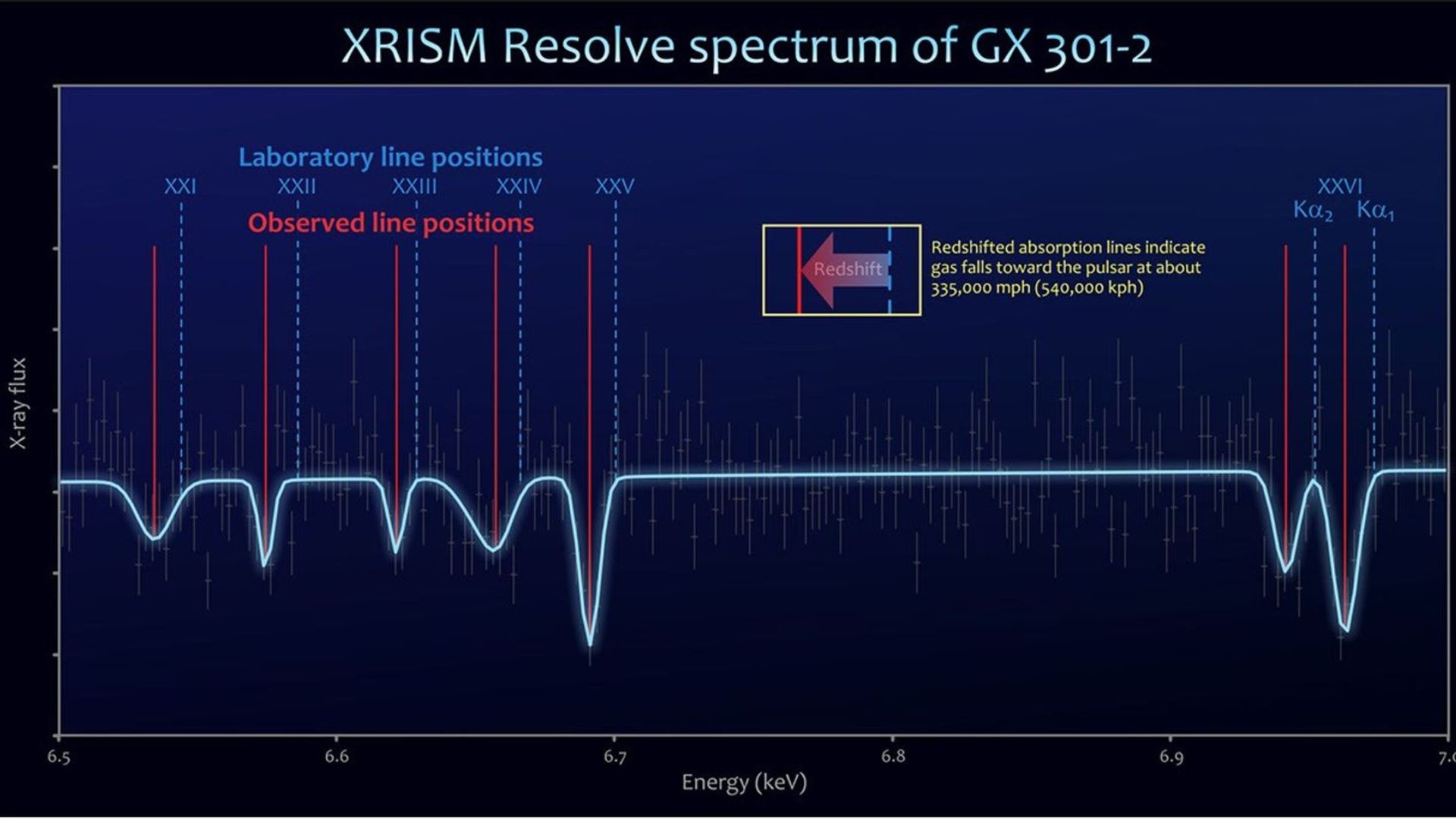
XRISM was able to capture detailed spectra of GX 301-2 and Wray 77’s plasma plume, allowing the researchers to accurately simulate how the stellar wind material interacted with the neutron star.
(Image credit: NASA’s Goddard Space Flight Center, JAXA/NASA, Rahin et al. 2026)
During a 16-hour observation period coinciding with one of the neutron star’s flares, researchers used XRISM to capture highly detailed X-ray spectra, revealing “rapidly changing emission and absorption lines” that showed how the plume ebbed and flowed around GX 301-2, NASA representatives wrote.
“We could see how the dense stream of plasma acts very close to the neutron star,” study co-author Nazma Islam, an astronomer at the Manipal Centre for Natural Sciences in India and formerly a researcher at UMBC and NASA Goddard, said in the statement. “It was clear that these observations were groundbreaking, but at the same time this meant the analysis had to be especially detailed.”
Using this data, the researchers could simulate exactly how the plasma fell onto and swirled around the passing neutron star. When enough stellar material has accumulated on its surface, the stellar zombie explodes, unleashing the bright flashes we can detect on Earth.
The team now hopes to use XRISM to study future flaring events to better understand the relationship between GX 301-2 and Wray 977’s windy plume.
“The BP Crucis system is an ideal laboratory for studying wind-fed pulsar accretion,” Brian Williams, XRISM project scientist at NASA Goddard, said in the statement, and XRISM is “an ideal instrument for advancing our understanding of the processes involved.”
Rahin, R., Ballhausen, R., Islam, N., Leutenegger, M. A., Behar, E., Zamora, D., Coley, J., Hell, N., Kallman, T., Lorenz, M., Pradhan, P., Wilms, J., & Zainab, A. (2026). Direct spectroscopic observation of matter falling onto a compact stellar object. Science Advances, 12(38), eaef6686. https://doi.org/10.1126/sciadv.aef6686
for informational purposes only. We do not claim ownership, accuracy, or liability for the content provided. All rights belong to the original publisher.
Contains information related to marketing campaigns of the user. These are shared with Google AdWords / Google Ads when the Google Ads and Google Analytics accounts are linked together.
90 days
__utma
ID used to identify users and sessions
2 years after last activity
__utmt
Used to monitor number of Google Analytics server requests
10 minutes
__utmb
Used to distinguish new sessions and visits. This cookie is set when the GA.js javascript library is loaded and there is no existing __utmb cookie. The cookie is updated every time data is sent to the Google Analytics server.
30 minutes after last activity
__utmc
Used only with old Urchin versions of Google Analytics and not with GA.js. Was used to distinguish between new sessions and visits at the end of a session.
End of session (browser)
__utmz
Contains information about the traffic source or campaign that directed user to the website. The cookie is set when the GA.js javascript is loaded and updated when data is sent to the Google Anaytics server
6 months after last activity
__utmv
Contains custom information set by the web developer via the _setCustomVar method in Google Analytics. This cookie is updated every time new data is sent to the Google Analytics server.
2 years after last activity
__utmx
Used to determine whether a user is included in an A / B or Multivariate test.
18 months
_ga
ID used to identify users
2 years
_gali
Used by Google Analytics to determine which links on a page are being clicked
30 seconds
_ga_
ID used to identify users
2 years
_gid
ID used to identify users for 24 hours after last activity
24 hours
_gat
Used to monitor number of Google Analytics server requests when using Google Tag Manager