Disclaimer: This article has been automatically aggregated from
Scientists have created the most accurate atomic clock ever made — and it could literally redefine the second.
Researchers recently unveiled the record-breaking device, which uses the vibration of atoms of an element called lutetium to precisely measure each microsecond. It is accurate up to 19 decimal places —a 41% improvement over the previous record holder. The results were published Sept. 23 in the journalNature.
Atomic clocks have been around since the 1950s. The first atomic clocks were made with the radioactive isotopes of the element cesium, a silvery metal that quickly became the gold standard for timekeeping. The International Bureau of Weights and Measures (BIPM) revised its definition of the second in 1968 to one based on the radiation emitted from cesium-133. Officially, 9.19 billion vibrations of a cesium-133 atom mark one second. (Prior to this, a second was defined as 1/31,556,925 of the length of the solar year 1900.)
Latest Videos FromLive Science
Cesium clocks helped standardize the second into something equally useful for both scientific and everyday timekeeping. Since the 1960s, other radioactive metals, including ytterbium and strontium, have been used to make atomic clocks. Today, they are the cornerstone for systems such as GPS, the internet and military technology.
But even modern, ultraprecise atomic clocks have limitations. For example, they are affected by minuscule fluctuations in temperature, magnetic fields and gravity. According to the researchers, the newly developed clock largely sidesteps those issues.
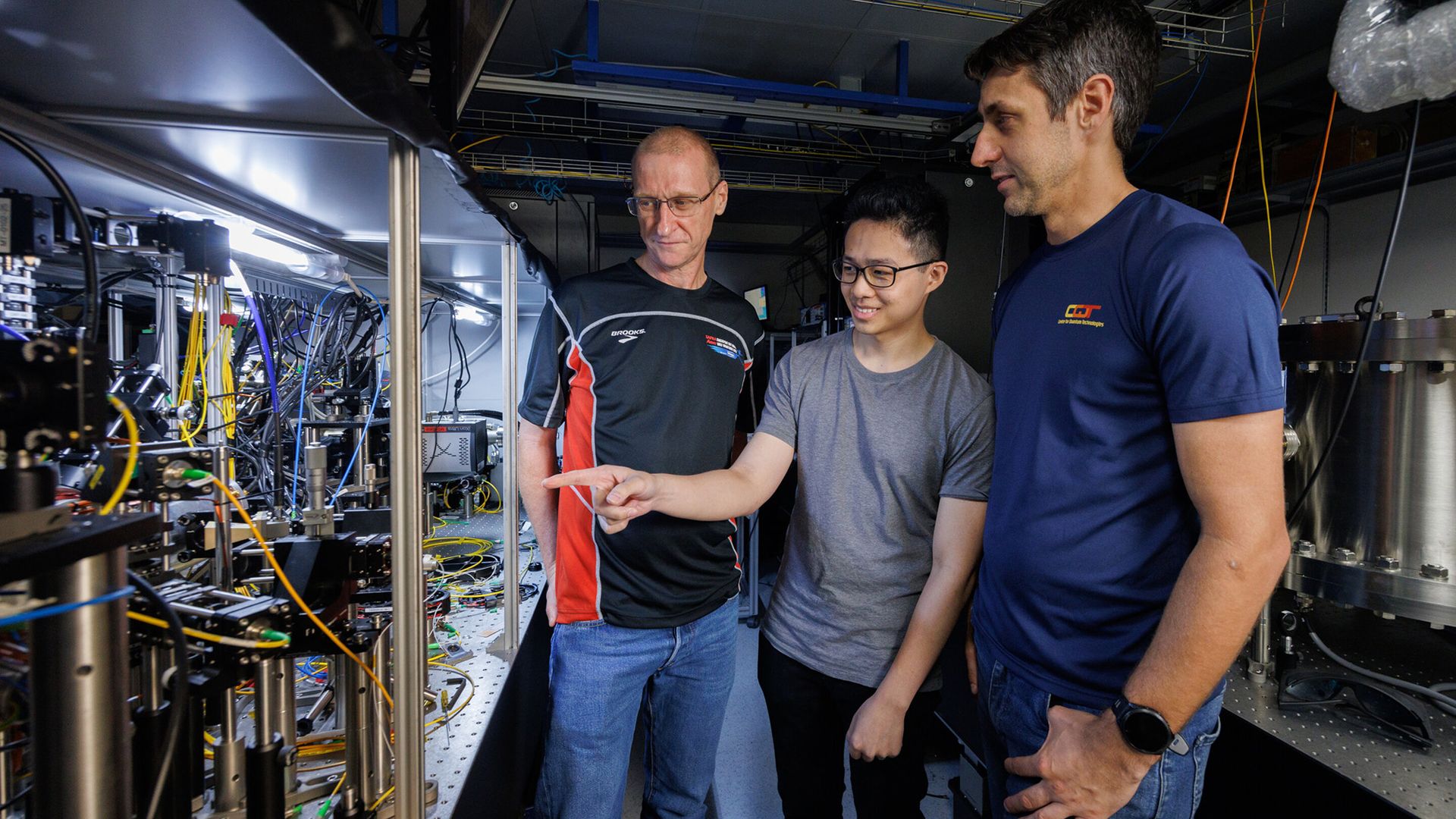
Physicists at the National University of Singapore inspect their super-accurate atomic clock in the lab.
(Image credit: Centre for Quantum Technologies, National University of Singapore)
To understand the challenge, imagine precise timekeeping as an ultramarathon and the clock’s core elemental isotope as a runner, said study co-authorMurray Barrett, a physicist at the National University of Singapore. “Our job is to make sure the runner can go the distance. Lutetium, as it turns out, is a natural born endurance athlete,” he told Live Science in an email.
Unlike previous atomic clocks, the team’s lutetium-176 clock is not very sensitive to external factors, especially magnetic fields and temperature. Whereas other elements might need environmental temperatures calibrated within a few thousandths of a degree, lutetium-176 keeps ticking even with a 5-degree external temperature swing. Barrett’s lab also developed a technique called hyperfine averaging to dull the most important environmental effects, like gravitational fields, leaving very little variation in timekeeping.
Get the world’s most fascinating discoveries delivered straight to your inbox.
Such a sensitive atomic clock could become the International System of Units’ – a.k.a., the metric system – new gold standard, the team said. The BIPM is expected to redefine the second in 2030 based on modern atomic clock technology. So far, lutetium seems to be the front-runner for accuracy.
The new atomic clock could also help scientists understand something even more basic about the universe: whether the constants at the foundation of physics, such as G, the gravitational constant,are as constant as we think. “There is some speculation that fundamental constants may actually be changing,” Barrett said. “So ultra-precise clocks give us the tools to explore that.”
Arnold, K. J., Lee, M. D. K., Zhao, Q., Qin, Q., Zhang, Z., Jayjong, N., & Barrett, M. D. (2026). Lu+ optical frequency references with accuracy verified at the 19th digit. Nature. https://doi.org/10.1038/s41586-026-11072-8
for informational purposes only. We do not claim ownership, accuracy, or liability for the content provided. All rights belong to the original publisher.
Contains information related to marketing campaigns of the user. These are shared with Google AdWords / Google Ads when the Google Ads and Google Analytics accounts are linked together.
90 days
__utma
ID used to identify users and sessions
2 years after last activity
__utmt
Used to monitor number of Google Analytics server requests
10 minutes
__utmb
Used to distinguish new sessions and visits. This cookie is set when the GA.js javascript library is loaded and there is no existing __utmb cookie. The cookie is updated every time data is sent to the Google Analytics server.
30 minutes after last activity
__utmc
Used only with old Urchin versions of Google Analytics and not with GA.js. Was used to distinguish between new sessions and visits at the end of a session.
End of session (browser)
__utmz
Contains information about the traffic source or campaign that directed user to the website. The cookie is set when the GA.js javascript is loaded and updated when data is sent to the Google Anaytics server
6 months after last activity
__utmv
Contains custom information set by the web developer via the _setCustomVar method in Google Analytics. This cookie is updated every time new data is sent to the Google Analytics server.
2 years after last activity
__utmx
Used to determine whether a user is included in an A / B or Multivariate test.
18 months
_ga
ID used to identify users
2 years
_gali
Used by Google Analytics to determine which links on a page are being clicked
30 seconds
_ga_
ID used to identify users
2 years
_gid
ID used to identify users for 24 hours after last activity
24 hours
_gat
Used to monitor number of Google Analytics server requests when using Google Tag Manager