

Could ‘body clocks’ play a role in depression? Study proposes a new ‘circadian’ subtype
[post_content]
Disclaimer: This article has been automatically aggregated from
Some people with depression sleep far more than average, wake up exhausted, habitually stay up late, and experience mood shifts with the seasons. A new study suggests that these symptoms may cluster in a distinct subtype of depression that’s tied to the body’s internal clock.
While research has long linked a scrambled circadian rhythm to a risk of mood disorders, neuroscientists are now proposing that these disruptions define a specific form of depression that they call “circadian depression.” First conceptualized in 2021, the body-clock subtype may affect about 1 in 4 people with severe, recurrent or persistent depression, the researchers estimate.
In their new study, published Wednesday (Oct. 21) in The British Journal of Psychiatry, the team identified the subtype in about 2,600 people out of over 11,000 evaluated.
Latest Videos FromLive Science
“Circadian depression is a biologically informed subtype,” said study co-author Emiliana Tonini, a neuroscientist at the University of Sydney. “Unlike subtypes defined mainly by symptoms, the core feature here is a disturbed circadian system, which common antidepressants may not fully address,” Tonini told Live Science in an email.
The researchers think treatments that target the sleep-wake system, such as the sleep hormone melatonin or bright light therapy, might be beneficial for people with this subtype. However, because the subtype is still a proposal and not formally established yet, other experts say that further research is needed before the findings can inform clinical practice.
More than just bad sleep
Tonini and her team analyzed data from 11,380 adults ages 18 to 90 who took part in the Australian Genetics of Depression Study (AGDS), a nationwide study exploring how genes and life experiences influence depression and responses to treatment. They classified participants under the “circadian” umbrella if they had at least three of six features: seasonal mood swings, late sleep schedules, social jet lag (a mismatch between sleep routine during workdays and free days), night-owl habits, excessive sleep (hypersomnia), and fatigue upon waking.
A total of 2,604 people fit the proposed subtype. Compared with others in the AGDS cohort, this group was younger and developed depression earlier in life — around 19, compared with about 23 for the rest of the cohort.
Get the world’s most fascinating discoveries delivered straight to your inbox.
The group also skewed female, and individuals reported greater psychological distress, frequent suicidal thoughts and more physical complaints than people who didn’t fit the proposed subtype. Some experienced weight gain during depressive episodes and symptoms resembling hypomania, a revved-up state of elevated mood and energy that’s milder than full-blown mania.
However, having this constellation of symptoms doesn’t mean someone’s biological clock is disrupted, said Brant Hasler, a psychologist and sleep researcher at the University of Pittsburgh who was not involved in the study. The researchers relied on the participants’ self-reports of their sleep patterns; that data correlates only modestly with direct measures of circadian timing, such as measurements of melatonin in saliva, he said in an email.
“One can identify as an evening-type, and report later sleep timing, and still have physiological circadian timing that is not particularly delayed,” he said.
So, in addition to checking symptoms, the team hunted for genetic clues underlying the proposed subtype. They analyzed DNA from participants’ saliva samples and calculated “polygenic risk scores,” which add up the influence of thousands of different genetic variants to estimate how likely someone is to develop a given condition.
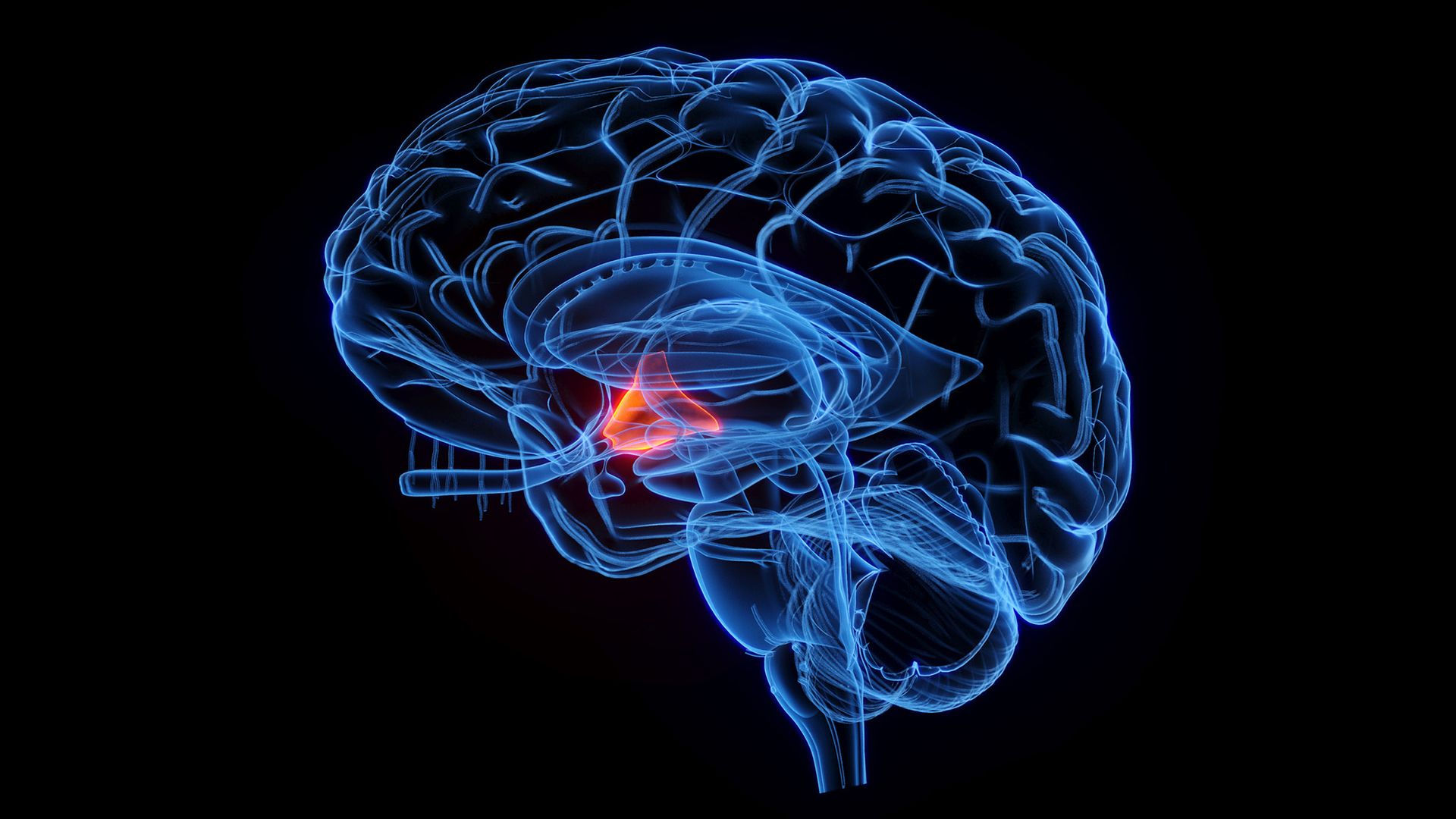
The body’s sleep-wake cycle is largely controlled by a hub of cells within the hypothalamus (red).
(Image credit: SEBASTIAN KAULITZKI/SCIENCE PHOTO LIBRARY via Getty Images)
“Mental health conditions are shaped by hundreds or thousands of variants that each add a small amount of risk, so everyone carries a unique ‘portfolio’ of risk,” Tonini explained.
People in the circadian group had a higher genetic risk for depression, anxiety, attention-deficit/hyperactivity disorder (ADHD) and bipolar disorder, the analysis suggested. They also had a greater genetic risk of higher body weight, insulin resistance, inflammation, insomnia and late-night sleep habits, compared with the other study participants.
This suggests “circadian depression is more than just ‘depression with bad sleep,'” Tonini said. “It involves a mix of metabolic, inflammatory, circadian, and mood-related processes.”
Could this change depression treatment?
The researchers looked at the participants’ past experiences with antidepressants, finding that the circadian group reported less benefit from common medications, such as selective serotonin reuptake inhibitors (SSRIs) and serotonin-norepinephrine reuptake inhibitors (SNRIs). Common examples include the SSRI Lexapro and the SNRI Cymbalta.
The circadian group also experienced more side effects from these treatments, such as drowsiness, nausea, anxiety and weight gain.
“If circadian disruption is a core biological mechanism in these individuals, treatments that fail to address those abnormalities may naturally be less effective,” said Dr. Ruth Benca, a psychiatrist and sleep researcher at Wake Forest University School of Medicine who was not involved in the study. However, Benca cautioned that body-clock disruption may not be the only reason standard drugs fall short for these patients.
“People with more pronounced circadian disturbances often have more severe illness and other psychiatric conditions, which can contribute to treatment resistance,” Benca told Live Science in an email.
Even so, tracking sleep, measurements of circadian rhythm, and seasonal shifts in mood could help clinicians identify at-risk patients earlier and select more effective treatments sooner in the course of illness, Benca suggested. “Potential approaches include behavioral routines, structured sleep schedules, or chronotherapy,” in which the timing of medication or light exposure is strategically coordinated with internal body rhythms, she added.
Clinical trials are still needed to draw firm conclusions about potential treatments, Tonini noted. The findings also must be validated in broader populations, since the study drew on a single Australian cohort and its genetic analysis included only people of European ancestry.
For now, “the study is an important step toward a more personalized treatment approach,” she said.
This article is for informational purposes only and is not meant to offer medical advice.
Tonini, E., Crouse, J. J., Shin, M., Carpenter, J. S., Mitchell, B. L., Byrne, E. M., Lind, P. A., Gordon, S. D., Parker, R., Hockey, S. J., To, T., Shim, A., Hill, A., Treneman, A., Scott, E., Scott, J., Merikangas, K. R., Wray, N. R., Martin, N. G., Medland, S. E., & Hickie, I. B. (2026). Clinical and genetic correlates of a circadian subtype of depression in the Australian Genetics of Depression Study. The British Journal of Psychiatry, 1–10. https://doi.org/10.1192/bjp.2026.10798
See how much you know about the most complex organ in the human body with our brain quiz!
for informational purposes only. We do not claim ownership, accuracy, or liability for the content provided. All rights belong to the original publisher.
Share this:
- Share on Facebook (Opens in new window) Facebook
- Share on X (Opens in new window) X
- Print (Opens in new window) Print
- Share on LinkedIn (Opens in new window) LinkedIn
- Share on Threads (Opens in new window) Threads
- Share on Mastodon (Opens in new window) Mastodon
- Share on Bluesky (Opens in new window) Bluesky
- Share on Telegram (Opens in new window) Telegram
- Share on Pinterest (Opens in new window) Pinterest
- Share on WhatsApp (Opens in new window) WhatsApp
- Share on Nextdoor (Opens in new window) Nextdoor
- Email a link to a friend (Opens in new window) Email
- Share on Tumblr (Opens in new window) Tumblr
- Share on Reddit (Opens in new window) Reddit