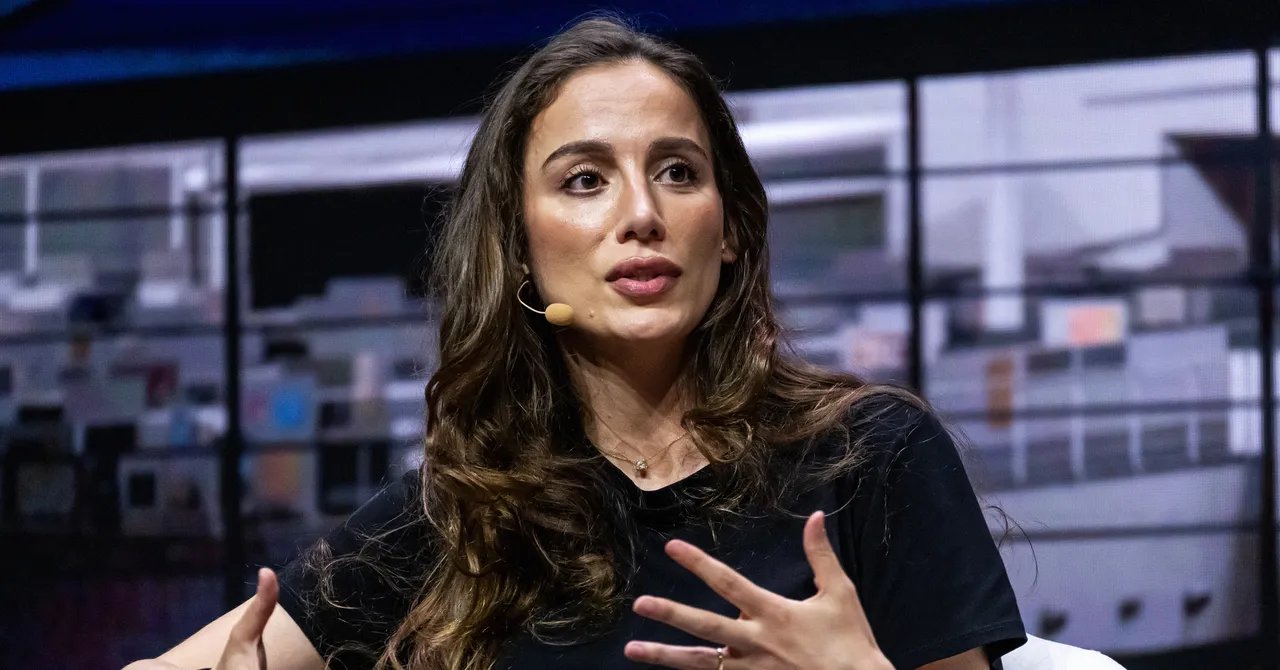
Mira Murati still wants to build AI superintelligence. But the ex-CTO of OpenAI sees human intelligence as a critical part of the equation.
At a time of rising worry over AI eliminating jobs and increasing the power of few big companies, Murati’s startup, Thinking Machines Lab, offers a radically different vision of the technology.
“At some point we will have super-intelligent machines,” Murati tells WIRED. “But we think that the best way to actually have many possible futures—good futures—is to keep humans in the loop.”
Murati says AI doesn’t need to automate humans out of the equation. A more optimistic approach, she suggests, is to let people build and customize their own frontier AI models, then work with those models to achieve their goals.
This week, Thinking Machines previewed a new kind of AI model that it says points toward a more human-inclusive reality. The company’s “interaction models” are trained to communicate with a person through a camera and microphone. Unlike many existing voice-mode interfaces, the new models do not simply capture and transcribe speech, then feed it into a language model that processes it in the same way as a chatbot. The interaction models natively understand continuous, messy, human communication—meaning they are better able to grasp the meaning of pauses, interruptions, and changes in tone. This allows them to adapt on the fly when someone clarifies a point or changes the subject. The company showed off several videos demonstrating these capabilities, though the models have not been released publicly.
Murati’s approach stands in contrast to how most big AI companies seem to be pursuing superintelligence today. OpenAI, Anthropic, Google are developing large models that do increasingly complex work, including writing entire software applications from scratch, via a text prompt. This requires little help from a human.
Thinking Machines is not the only startup to envision a more human-inclusive future. Other labs, including Humans&, also aim to develop AI systems that prioritize human collaboration. Some prominent economists have called for AI researchers and companies to build systems in this way, focusing on human empowerment rather than replacement.
Murati left her role as the chief technology officer of OpenAI in 2024, cofounding Thinking Machines with several prominent engineers. Thinking Machines has raised billions of dollars to build frontier AI.
So far, however, the company has released only one product. Tinker, launched in October 2025, makes it possible to refine a frontier AI model using custom data. Today, it is available as an API that researchers and engineers can use to fine-tune open source models.
Alexander Kirillov, a founding team member of Thinking Machines and an expert on multimodal AI, meaning models that handle audio and video as well as text, says the lab’s new interaction models also have the potential to enable more customized and personalized AI.
“The model constantly perceives what you’re doing and is constantly there to be able to reply and give you information or search for information or use other tools,” Kirillov says. “This is something that none of [today’s other] models can actually do. The turns [in a conversation] are determined by a much less intelligent system.”
Mira says it’s all part of a bigger AI vision.
“This is showing the first bet on human collaboration,” she explains. “Where this is going is really amplifying people’s own preferences and values, with AI actually understanding intent and predicting intent.”