Disclaimer: This article has been automatically aggregated from
A new analysis of a decades-old photo is revealing new details about a powerful woman who ruled Egypt 5,000 years ago, a new study finds.
The woman, named Meretneith (also spelled Merneith or Meret-Neith), reigned during the first dynasty, a time not long after Egypt was united under a single ruler, according to the new research. The study, published in the September issue of the journal Prague Egyptological Studies, enhanced an old photo of a now lost artifact revealing that Meretneith’s name was written in a way reserved for a ruler for Egypt.
The finding was more than 70 years in the making. In the 1940s, archaeologist William B. Emery found 13 mud stoppers, or seals that identify an object’s owner, around the mouth of a tomb shaft at Saqqara. Each contained a series of four serekhs — a series of signs that gave the name of a ruler of Egypt. He identified two of the serekhs as belonging to a king named Djer and suggested that the other two belonged to a woman named Meretneith.
Latest Videos FromLive Science
The presence of Meretneith’s name in the serekhs indicates that she was a ruler of Egypt, he said. In a 1954 journal article, he published a black-and-white photograph of one of the mud stoppers. However, the poor quality of the photo meant many scholars were unconvinced.
Further complicating the investigation, all 13 of the mud stoppers, as well as the photograph’s original glass plate, have gone missing since the excavations. Their whereabouts are “unknown,” Susan Kelly, an Egyptology researcher at Macquarie University in Australia and co-author of the new paper, told Live Science in an email.
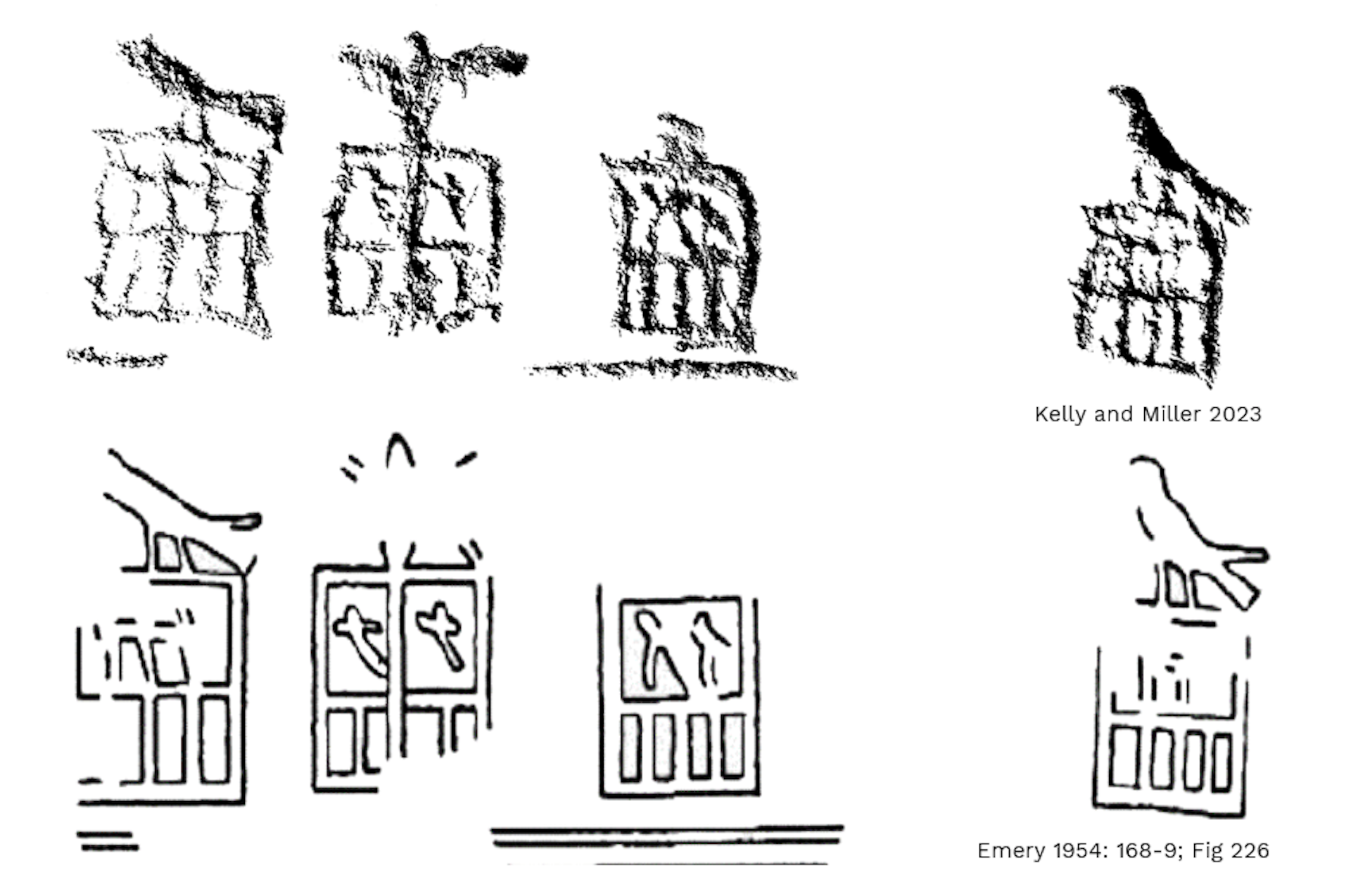
This leaves only the black-and-white photograph. In the new study, Kelly and Crystal Miller, a technician at the same university who is now getting a master’s degree in bioarchaeology, used a series of complex techniques to create digital enhancements of the photo that elucidated more details of the serekhs.
“Our technique has revealed that in the second and third serekhs, the signs in the name portion of the emblem are consistent with the main sign used to write Meretneith’s name” Kelly wrote in an article for The Conversation.
Get the world’s most fascinating discoveries delivered straight to your inbox.
A comparison of a new digital “rubbing” of the ancient Egyptian serekhs (first attained in 2023) and Emery’s 1954 sketches.
(Image credit: Author provided)
The “king’s mother”
Meretneith’s role would not have been the same as her male counterparts’. Inscriptions of her found at different sites do not use the serekh, but they do accord her titles such as “king’s mother” or name her as being in charge of important departments, such as the treasury, Kelly and Miller wrote in their paper.
“Meretneith may have had the advantage of stepping on and off the rulership platform as necessitated by the political environment,” they added, unlike male rulers who succeeded, reigned, died, and were buried by their successors.” When necessary she could become the ruler, and when a male family member was able to rule, she could be a powerful royal family member who assisted the ruler. Her son King Den might have been the one to bury her.
The evidence suggests that she was a joint ruler with a man named Djer. We don’t know for sure who Djer was, but he may have been her father, Kelly told Live Science in an email. She also may have acted as a regent for her son Den when he was too young to rule alone.
After her death, she was given a tomb of a similar size and construction to that of a ruler, excavations from 2023 suggest.
However, Eva-Maria Engel, a historian at the Humboldt University of Berlin who was not involved in the new study, disputed some of the study’s findings. She studied the photograph enhancements published in the paper but doesn’t think Meretneith is among the names in the serekhs. From the enhancements, it appears that “the seal only mentions the name of King Djer and that Meretneith is not mentioned at all,” Engel told Live Science in an email.
That doesn’t mean Meretneith wasn’t powerful, however. Engel noted that Meretneith “had a tomb among the earlier and later kings,” with inscriptions found at other sites indicating that she acted on behalf of her son, King Den, when he was too young to effectively rule.
Are you a fan of mummies and hieroglyphs? Find out with our ancient Egypt quiz!
for informational purposes only. We do not claim ownership, accuracy, or liability for the content provided. All rights belong to the original publisher.
Contains information related to marketing campaigns of the user. These are shared with Google AdWords / Google Ads when the Google Ads and Google Analytics accounts are linked together.
90 days
__utma
ID used to identify users and sessions
2 years after last activity
__utmt
Used to monitor number of Google Analytics server requests
10 minutes
__utmb
Used to distinguish new sessions and visits. This cookie is set when the GA.js javascript library is loaded and there is no existing __utmb cookie. The cookie is updated every time data is sent to the Google Analytics server.
30 minutes after last activity
__utmc
Used only with old Urchin versions of Google Analytics and not with GA.js. Was used to distinguish between new sessions and visits at the end of a session.
End of session (browser)
__utmz
Contains information about the traffic source or campaign that directed user to the website. The cookie is set when the GA.js javascript is loaded and updated when data is sent to the Google Anaytics server
6 months after last activity
__utmv
Contains custom information set by the web developer via the _setCustomVar method in Google Analytics. This cookie is updated every time new data is sent to the Google Analytics server.
2 years after last activity
__utmx
Used to determine whether a user is included in an A / B or Multivariate test.
18 months
_ga
ID used to identify users
2 years
_gali
Used by Google Analytics to determine which links on a page are being clicked
30 seconds
_ga_
ID used to identify users
2 years
_gid
ID used to identify users for 24 hours after last activity
24 hours
_gat
Used to monitor number of Google Analytics server requests when using Google Tag Manager