

Australia’s bizarre ‘Spider Crater’ seen from orbit photo of the day for Oct. 22, 2026
[post_content]
Disclaimer: This article has been automatically aggregated from
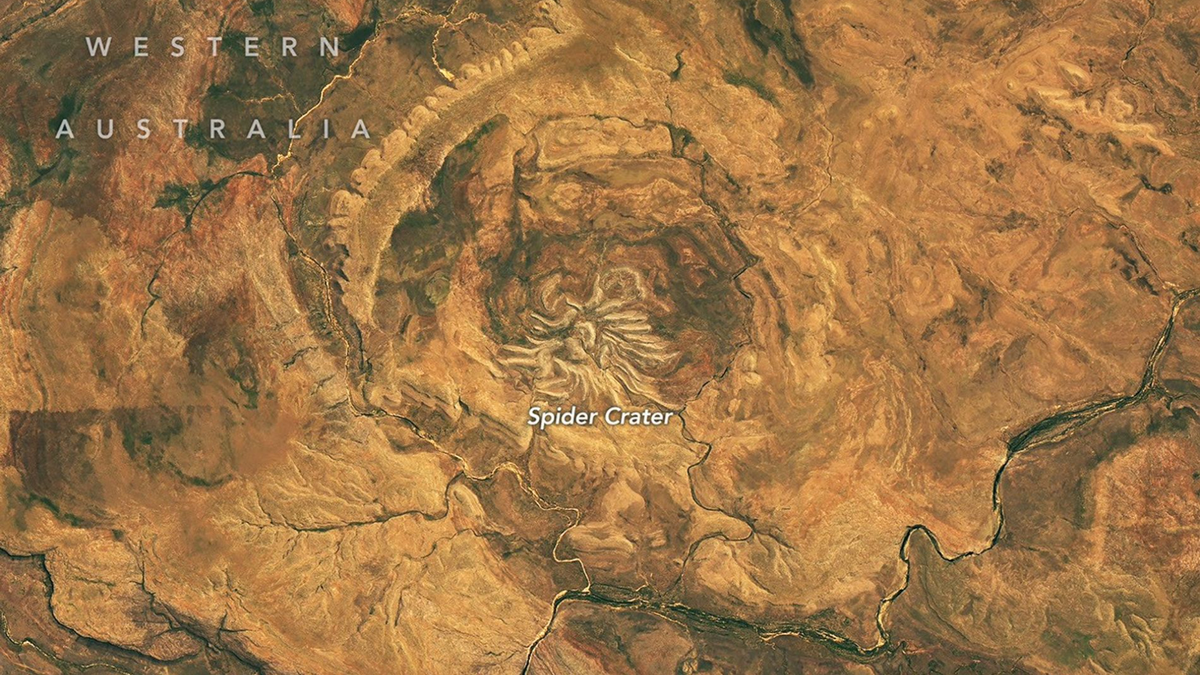
From the dangerous Sydney funnel-web to the common huntsman, Australia is home to its fair share of spiders. It even has a crater shaped like one.
What is it?
One stretch of the vast Western Australia wilderness is imprinted with a curious crater, which likely formed after a meteor impact hundreds of millions of years ago. Geologists think the spider-like pattern in the crater’s center was created when its floor rebounded following the initial impact, NASA has said.
In the hundreds of millions of years since the initial impact, erosion has continued to carve this formation into its current, signature shape. Complete with “legs,” the planetary imprint has earned its name Spider Crater.
This image shows the impact structure in its entirety, which stretches 8 by 7 miles (13 by 11 kilometers) in full, with the central “spider” piece measuring 2.5 miles (4 km).
Why is it incredible?
In this image, we can see this “spider” from space. This snapshot shows the geologic feature as captured by the OLI (Operational Land Imager) aboard the Landsat 9 satellite, an Earth-observing craft that launched back in 2021.
The satellite, a collaborative effort between NASA and the U.S. Geological Survey, is the ninth in the Landsat Earth-observing series, which goes all the way back to the launch of Landsat 1 in 1972. On a near-weekly basis, Landsat 9 delivers observations of everything from deforestation to water quality and crop growth.
The series of Landsat satellites have been a critical piece in the modern understanding of how our planet continues to change. Whether it’s the repercussions of climate change or fluctuations in agriculture, observations from orbit do more than provide interesting photos of our home world; they also capture critical data.
for informational purposes only. We do not claim ownership, accuracy, or liability for the content provided. All rights belong to the original publisher.