

I asked ChatGPT, Gemini and Perplexity to plan the same Disney World vacation — one cost $5,000 more
[post_content]
Disclaimer: This article has been automatically aggregated from
Planning a Disney World vacation is practically a part-time job — and as a former cast member, I know personally what each park has to offer. Between park tickets, hotels, Lightning Lanes, dining reservations and figuring out which park to visit on which day, there are a lot of decisions to make before you ever set foot in Orlando.
So I wondered whether AI could do the hard part for me.
I gave ChatGPT, Gemini and Perplexity exactly the same assignment with the prompt: Plan a five-day Walt Disney World vacation for my family of five, including two adults and three kids ages 12, 10 and 6. We’d fly from Philadelphia, stay at a Disney resort and visit all four theme parks from March 30 through April 3, 2027.
Latest Videos FromTom’s Guide
I didn’t just ask for an itinerary. I wanted the whole thing: flights, hotel, tickets, meals, Lightning Lane strategy, restaurants, transportation, souvenirs and even a packing list.
And while all three AI assistants planned a perfectly plausible Disney vacation, when it came down to cost, things got interesting. Here’s a look at what happened.
ChatGPT made a major error
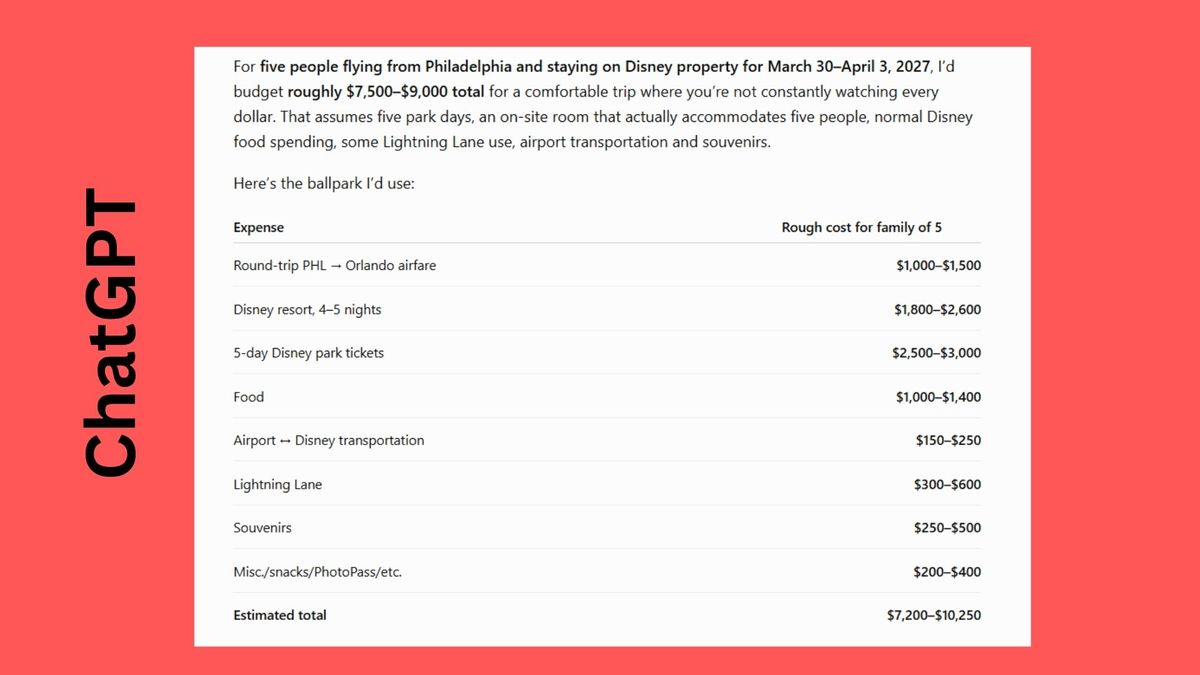
ChatGPT gave me the cheapest Disney vacation, initially estimating that my family should expect to spend roughly $7,500 to $9,000 for the entire vacation.
Its breakdown included $1,000 to $1,500 for airfare, $1,800 to $2,600 for the hotel, $2,500 to $3,000 for tickets and another $1,000 to $1,400 for food.
It recommended setting aside about $8,500 as a realistic target.
There was just one pretty big problem: the hotel.
ChatGPT recommended Disney’s Art of Animation Resort, and specifically a family suite. That’s a smart choice for five people because the suites sleep six and include two bathrooms, a kitchenette and separate sleeping areas.
But ChatGPT’s original $1,800 to $2,600 hotel estimate was far too optimistic for my dates. And that’s an error that can matter a lot.
Gemini caught the expense ChatGPT missed
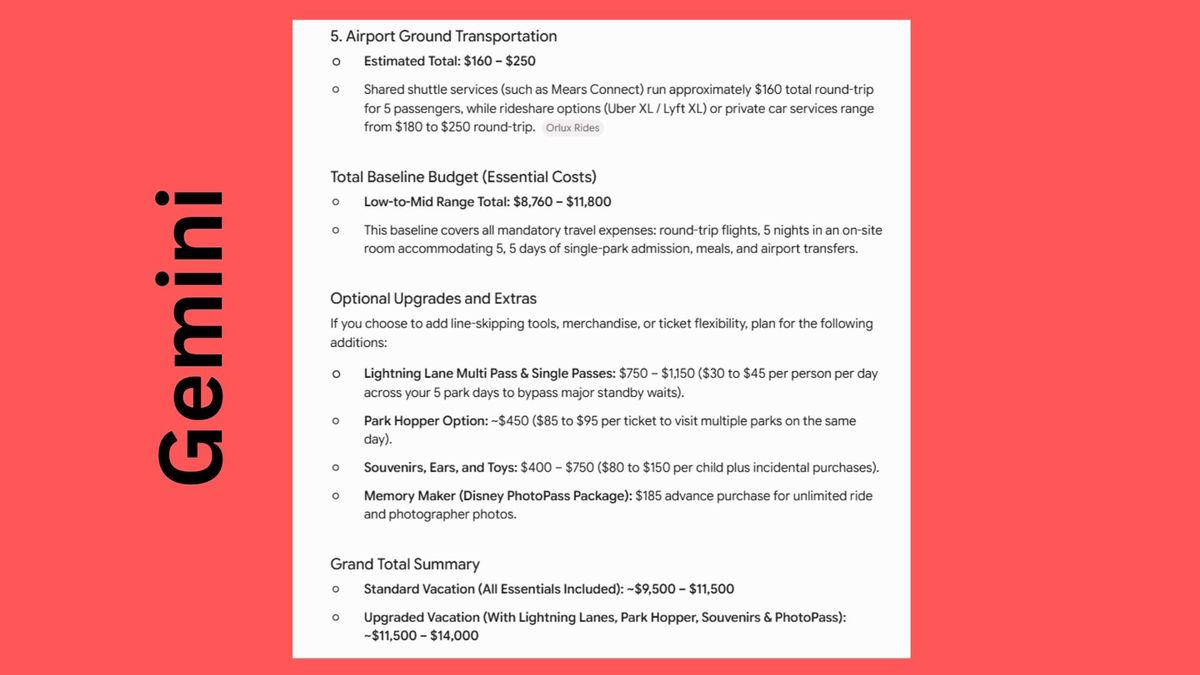
Gemini looked at the same vacation and came back with a considerably higher number.
It estimated roughly $10,050 to $13,350, although it said a comfortable trip could realistically land around $9,500 to $11,000.
The biggest difference was the hotel.
Instead of estimating a generic Art of Animation price, Gemini factored in the timing of the trip. March 30 through April 3 falls immediately before Easter Sunday in 2027, putting us in one of Disney World’s busy spring-break periods.
Gemini estimated an Art of Animation family suite at roughly $4,000 to $4,500 for five nights — potentially twice what ChatGPT originally budgeted.
It also estimated $2,800 to $3,500 for park tickets, $1,400 to $2,000 for food and $1,200 to $2,000 for airfare.
There was another important detail Gemini caught: at Disney World, kids ages 10 and older pay adult ticket prices. That means only one of my three children qualifies for a child’s ticket. Ouch!
Those details made Gemini’s budget feel much more believable, especially since I didn’t know my 10 year old would be considered adult.
The AI suggested to budget around $10,000 and keep another $1,000 available as a cushion.
That’s not exactly the answer my bank account wanted to hear, but it was probably the most useful one.
Perplexity planned the most expensive vacation
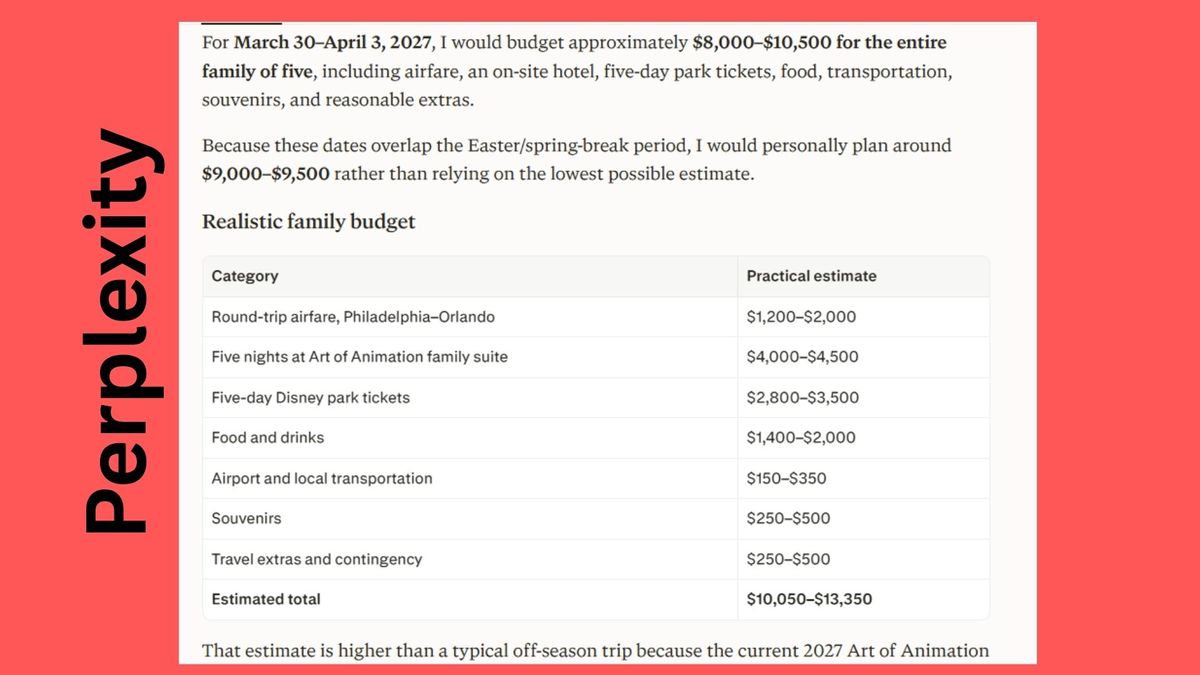
Perplexity’s essential vacation estimate alone came to approximately $8,760 to $11,520.
Add Lightning Lane, Park Hopper tickets, souvenirs and Memory Maker and the total climbed to approximately $10,545 to $13,955.
Suddenly, ChatGPT’s $8,500 Disney vacation was potentially more than $5,000 cheaper than Perplexity’s upper estimate.
But Perplexity wasn’t necessarily wrong. It was budgeting for a different style of vacation.
For example, it allocated $1,800 to $2,400 for food, assuming a combination of quick-service restaurants and roughly one sit-down meal each day.
It also allowed another $750 to $1,100 for Lightning Lane over five days. That’s substantially more than I would probably spend on either.
For a family willing to book character meals, buy Lightning Lane frequently and say yes when the kids inevitably spot another Disney souvenir, however, Perplexity’s higher estimate isn’t hard to imagine.
Perplexity actually gave me my favorite itinerary

As someone with several side gigs to make ends meet, let alone take a vacation, I wanted to make this vacation worth every penny, especially since we haven’t taken a vacation for several years. That said, price wasn’t the only thing I compared.
Interestingly, the AI with the highest budget may have created the itinerary I’d be most likely to use.
Perplexity suggested:
Day 1: Magic Kingdom
Day 2: Hollywood Studios
Day 3: EPCOT
Day 4: Animal Kingdom
Day 5: Magic Kingdom again
That makes sense for a family with three kids.
Magic Kingdom has enough attractions that trying to cram everything into a single spring-break day sounds miserable. Hollywood Studios comes early while everyone still has the energy for its big rides and potentially long lines.
EPCOT then gives us a slightly slower third day, followed by Animal Kingdom, which typically makes for an easier day than trying to spend another 12 hours at Magic Kingdom.
Then we get a second Magic Kingdom day to ride anything we missed.
Gemini had a slightly different idea. It suggested Magic Kingdom, EPCOT, Hollywood Studios and Animal Kingdom, followed by a fifth day using Park Hopper to start at Magic Kingdom and finish at EPCOT.
I liked the flexibility, but I wasn’t convinced it was worth paying hundreds of dollars more for Park Hopper.
All three agreed on one important Disney strategy

Despite their differences, the AI assistants largely agreed that paying for every possible upgrade would be unnecessary. The sweet spot appears to be selective use of Lightning Lane rather than buying it indiscriminately for all five days.
Magic Kingdom and Hollywood Studios are the obvious candidates because those parks have enough popular attractions to make skipping several long standby queues especially valuable.
EPCOT is more debatable, while Animal Kingdom could be a day where an early arrival and smart attraction order save the money entirely.
Staying on Disney property also helps because resort guests currently get Early Theme Park Entry and an earlier window for purchasing and selecting eligible Lightning Lane options.
For a family of five, that’s important. A $30-per-person upgrade isn’t $30 anymore. It’s $150 every time I tap the buy button.
Verdict: Gemini was the best Disney budgeter
If I were judging solely on itinerary, I’d give this one to Perplexity. But if I’m actually about to hand over my credit card, Gemini wins.
ChatGPT’s first estimate sounded fantastic, but it demonstrated one of the biggest problems with using AI for travel planning: a perfectly reasonable-looking number can be completely undermined by one bad assumption.
In this case, it was the hotel.
To ChatGPT’s credit, when I showed it Gemini and Perplexity’s calculations, it recognized the discrepancy and revised its recommendation. Its new target was approximately $10,000, with $11,000 available.
That puts all three AI assistants much closer together. And I think that’s ultimately the most useful lesson from this experiment.
AI is remarkably good at doing the tedious part of vacation planning. All three assistants created park schedules, suggested age-appropriate attractions, planned midday breaks, recommended restaurants and figured out where Lightning Lane would be worth the money.
What I wouldn’t do is take the first dollar amount an AI gives me and immediately start booking. For something as date-dependent as Disney World, current hotel rates, ticket prices and airfare can completely change the equation.
I’d happily let AI build my itinerary. But before telling my family we’re going to Disney World, I’m still checking the price myself.
Follow Tom’s Guide on Google News and add us as a preferred source to get our up-to-date news, analysis, and reviews in your feeds. Subscribe to Tom’s Guide on YouTube and follow us on TikTok.

More from Tom’s Guide
for informational purposes only. We do not claim ownership, accuracy, or liability for the content provided. All rights belong to the original publisher.