

Strange object firing a powerful beam of energy toward Earth could be the first known ‘microblazar’
[post_content]
Disclaimer: This article has been automatically aggregated from
Researchers have observed the strongest candidate yet for a “microblazar” — a dazzling object that has long been predicted to exist but never spotted.
Observations of microblazars would give astronomers closer views of black holes emitting powerful jets of energy and help them understand how these extreme objects behave.
Blazars are some of the most energetic objects in the universe. They are a type of quasar — a brightly glowing object fueled by a supermassive black hole stripping material from its host galaxy and then ejecting some of it in powerful, opposing jets of particles and radiation. To qualify as a blazar, one of those near-light-speed jets needs to point directly at Earth. Astronomers have previously discovered smaller versions of quasars, dubbed microquasars, and long theorized that there must be smaller versions of blazars as well.
Latest Videos FromLive Science
Now, an international team led by astronomers in Spain, the Netherlands and Argentina has described a microblazar in a study accepted for publication in the journal Astronomy and Astrophysics.
“It is the first time that we have a serious candidate,” Josep Martí, an astronomer at the University of Jaén in Spain and first author of the study, told Live Science.
The object, called IRAS 18293-0941, is located in our galaxy, about 12,000 light-years from Earth, and it’s hidden behind a veil of dust. It is a binary system that includes a black hole that orbits a hot, gigantic star every 11 days. Matter from the star falls into the black hole, and some of this material is jettisoned into the surrounding environment in two opposing jets. One of those jets flares toward Earth.
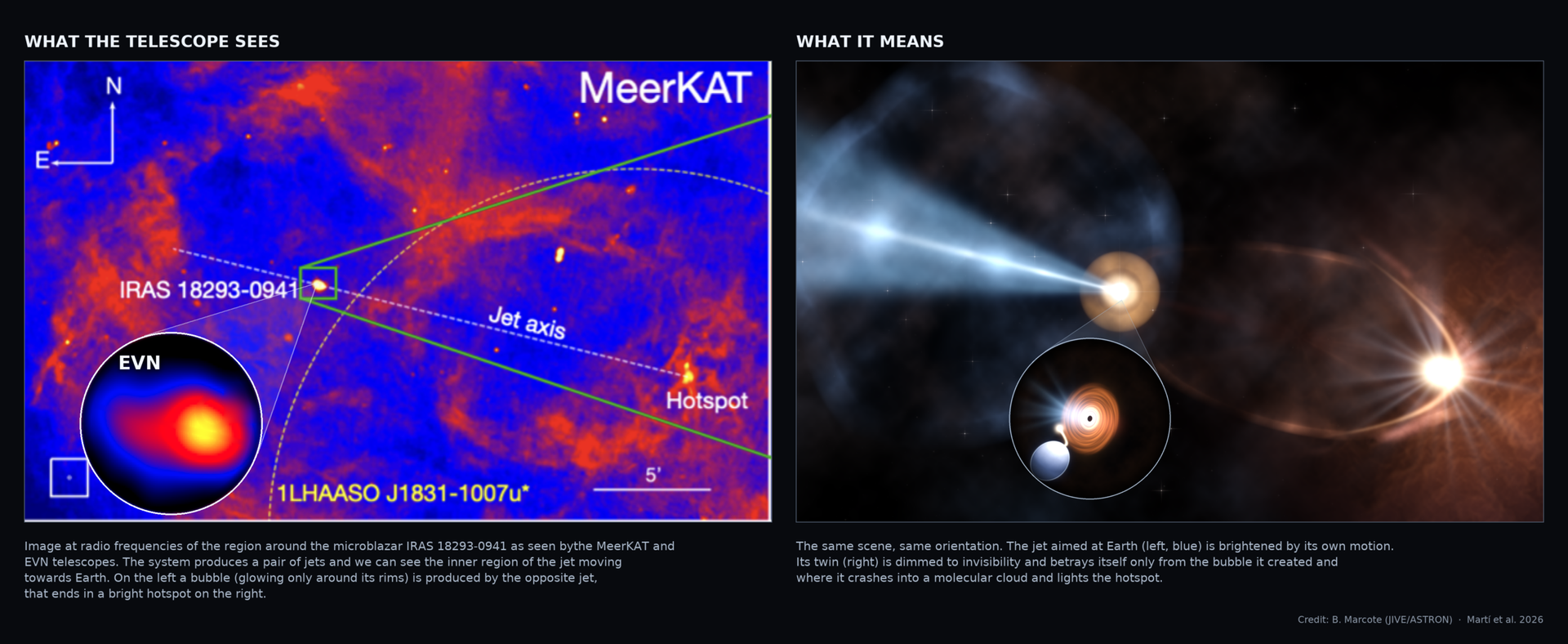
Comparison between the astronomical images of IRAS 18293-0941 (left) and the artist’s impression (right).
(Image credit: B. Marcote (JIVE/ASTRON).)
These objects, as well as microquasars in general, are tricky to observe, Martí said. “Because of stellar evolution, you need to catch the system at the right time,” he added. “The microquasar phase of evolution is very short, and so it is difficult to find one in that phase.”
Get the world’s most fascinating discoveries delivered straight to your inbox.
Theorists predicted that microblazars would have special characteristics that should help define them. These features include powerful emissions across the electromagnetic spectrum, rapid changes in brightness (variability), and a hotspot behind them where its opposing jet heats up the interstellar medium in the opposite direction of Earth.
To observe IRAS 18293-0941, the study authors used a variety of instruments — including the Calar Alto Astronomical Observatory in Spain, a network of radio astronomy telescopes called the European VLBI Network, and the MeerKAT radio telescope array in South Africa — as well as archival data from the Very Large Array in New Mexico.
They found that IRAS 18293-0941 has all of the expected microblazar characteristics, except one — variability. Microblazars have rapid variability, which means their brightness changes a lot in a short period, because one of the jets is facing Earth and small changes in brightness are amplified by an effect called Doppler boosting.
Martí said IRAS 18293−0941’s lack of rapid variability could be explained by the dense cloud of gas surrounding it, which could smooth out quick fluctuations in brightness.
The researchers are currently investigating whether the observed area behind the microblazar is in fact a hotspot, study co-author Pedro Luque-Escamilla, an astronomer at the University of Jaén, told Live Science.
Even with one of the expected features missing, this object is a promising candidate for the first known microblazar. “The claims and the results of the paper are sensible and there are no questionable hidden assumptions,” Kinwah Wu, a theoretical astrophysicist at University College London who was not involved in the research, told Live Science in an email. “The source in this paper had shown signatures of interactions between the jets and the ambient material, which naturally leads to [particle] interaction.”
Svetlana Jorstad, a senior research scientist at the Institute for Astrophysical Research at Boston University who was not involved in the research, told Live Science in an email that the new study was “very interesting, important and comprehensive.”
Itumeleng Monageng, an astronomer at the University of Cape Town who was also not involved in the research, added that the team’s observations “presents a previously overlooked mechanism for generating some of the highest energy emissions observed.”
Microblazars “may power some of the universe’s most energetic processes,” Monageng told Live Science in an email.
Martí, J., Luque-Escamilla, P. L., Marcote, B., Abaroa, L., Aguasca-Cabot, A., Combi, J. A., Romero, G. E., Paredes, J. M., García, F., Fogantini, F., Saavedra, E. A., Del Ser, D., & Van Den Eijnden, J. (2026). A Galactic microblazar as a potential accelerator of ultra-high-energy particles. Astronomy and Astrophysics. https://doi.org/10.1051/0004-6361/202661105
See how much you know about black holes with our black hole quiz!
for informational purposes only. We do not claim ownership, accuracy, or liability for the content provided. All rights belong to the original publisher.
Share this:
- Share on Facebook (Opens in new window) Facebook
- Share on X (Opens in new window) X
- Print (Opens in new window) Print
- Share on LinkedIn (Opens in new window) LinkedIn
- Share on Threads (Opens in new window) Threads
- Share on Mastodon (Opens in new window) Mastodon
- Share on Bluesky (Opens in new window) Bluesky
- Share on Telegram (Opens in new window) Telegram
- Share on Pinterest (Opens in new window) Pinterest
- Share on WhatsApp (Opens in new window) WhatsApp
- Share on Nextdoor (Opens in new window) Nextdoor
- Email a link to a friend (Opens in new window) Email
- Share on Tumblr (Opens in new window) Tumblr
- Share on Reddit (Opens in new window) Reddit