

The moon might be hiding a history of ancient supernova explosions
[post_content]
Disclaimer: This article has been automatically aggregated from
It’s now possible to disentangle the sprinkling of supernova dust on the moon from the lunar dirt it is mixed up in, thanks to a new computer model that opens up the moon’s surface as a time capsule holding details about the history of supernova explosions near the Earth as our solar system has travelled through space while orbiting the galaxy.
When stars explode as a supernova, they shower space with debris, some of which is in the form of radioactive isotopes traveling at high velocity. Some of these radioisotopes enter the solar system to fall on all the planets and moons, including Earth and its moon. Studies of radioisotopes in deep-sea sediments on Earth, coupled with those found in samples of lunar dirt – what scientists term ‘regolith’ – brought back by the Apollo missions, point to two recent peaks in supernova activity, 2.3 and 7.3 million years ago.
“I think it’s beautiful that the remains of past stars can be used to navigate the vast history of our Earth–moon neighborhood, if we have knowledge of how to read the stardust,” said planetary scientist Emily Costello, of the University of Hawaii at Mānoa, in a statement.
However, because of the process of erosion and subduction through plate tectonics, most Earth-bound records of supernova activity in our cosmic neighborhood have been lost and reliable records on Earth only go back about 10 million years. Earth’s moon, however, is a different story. Because the moon has no atmosphere, there’s no wind or rain erosion, nor are there any plate tectonics. The moon, therefore, should host a record of supernova activity going back 80–100 million years, or even longer.
However, while the moon lacks Earth’s style of erosion, it does experience what planetary scientists refer to as ‘impact gardening’. This is when impacts of objects ranging in size from microscopic micrometeorites to large asteroids, turns over the regolith, mixing it all up including the radioactive supernova debris.
In order to disentangle all this and work out at what depths various radioisotopes have been mixed down to, Costello’s team developed a mathematical model that can decode what treasures lie in the lunar regolith.
“To model impact gardening, we have to balance a complex web of physical mechanisms, including impact compaction, excavation, radioactive decay and space weathering, all operating simultaneously within a single, elegant continuum model,” said Costello.
“Our mathematical model treats lunar impact gardening as a competition between forces burying the soil and impacts digging it back up. It also accounts for radioactive decay of the star remnants while mapping exactly when and where new stardust was delivered by episodic supernovae.”
Costello’s team validated their model by comparing its predictions for the depth-concentration of supernova radioisotopes to what is found in Earth’s deep-sea sediments and the Apollo samples.
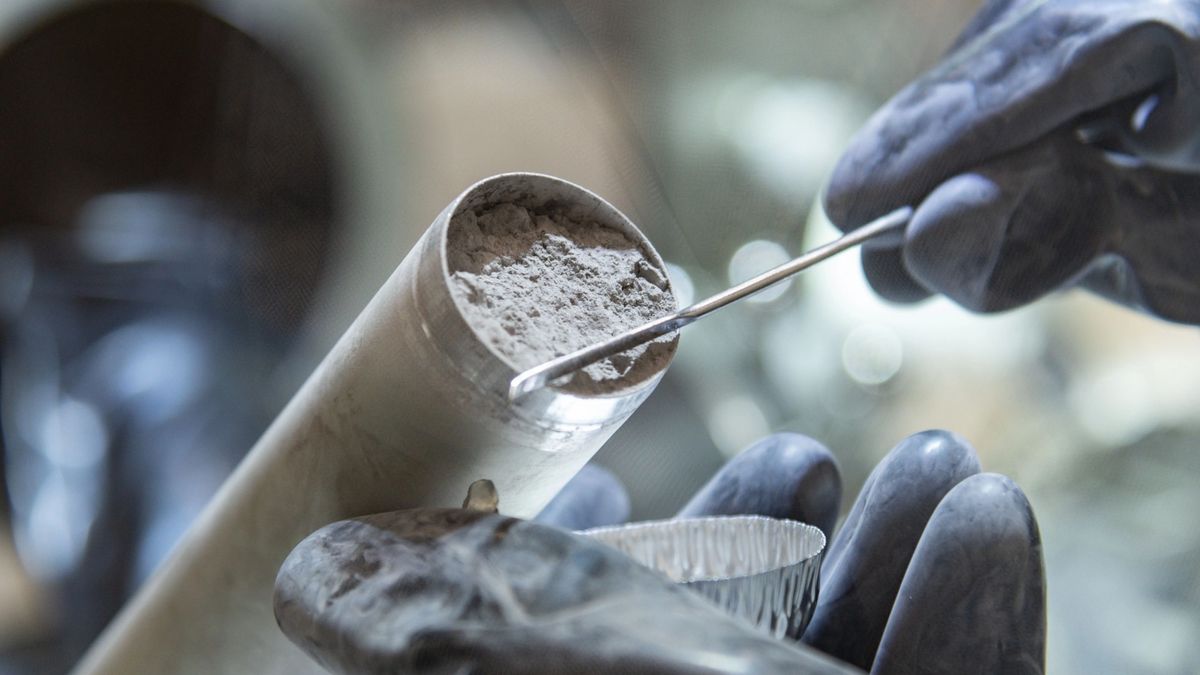
“When I first shared my model results, my colleagues were surprised by how well-matched the model and the measurements were,” said Costello, “This level of fidelity between empirical observations and a physics model is exciting and remarkable.”
Their model accurately predicted the depth-concentration profile of iron-60 found in Apollo regolith samples, as well as heavy elements such as plutonium-244, iodine-129, hafnium-182 and curium-247 that have all been buried over time.
However, the real science will begin when future Artemis astronauts bring back new lunar samples from deeper beneath the surface over the coming years.
“These future samples taken from the moon, when considered in conjunction with our gardening model, could reveal new insights into an untold chapter of supernova history,” said Costello. “Understanding the physics of regolith mixing ensures that when future astronauts return deeper cores, we can properly read the scrambled layers to reconstruct the history of our solar system’s journey through the galaxy.”
The findings were published on Aug. 14 in Physical Review Letters.
for informational purposes only. We do not claim ownership, accuracy, or liability for the content provided. All rights belong to the original publisher.