

The night we nearly saw a ‘blood moon’ (and why I love near-misses in astronomy)
[post_content]
Disclaimer: This article has been automatically aggregated from
Stargazers have trigger words — total, bright, peak, maximum, best. But observing the sky is often more interesting when something seems neither one thing nor the other.
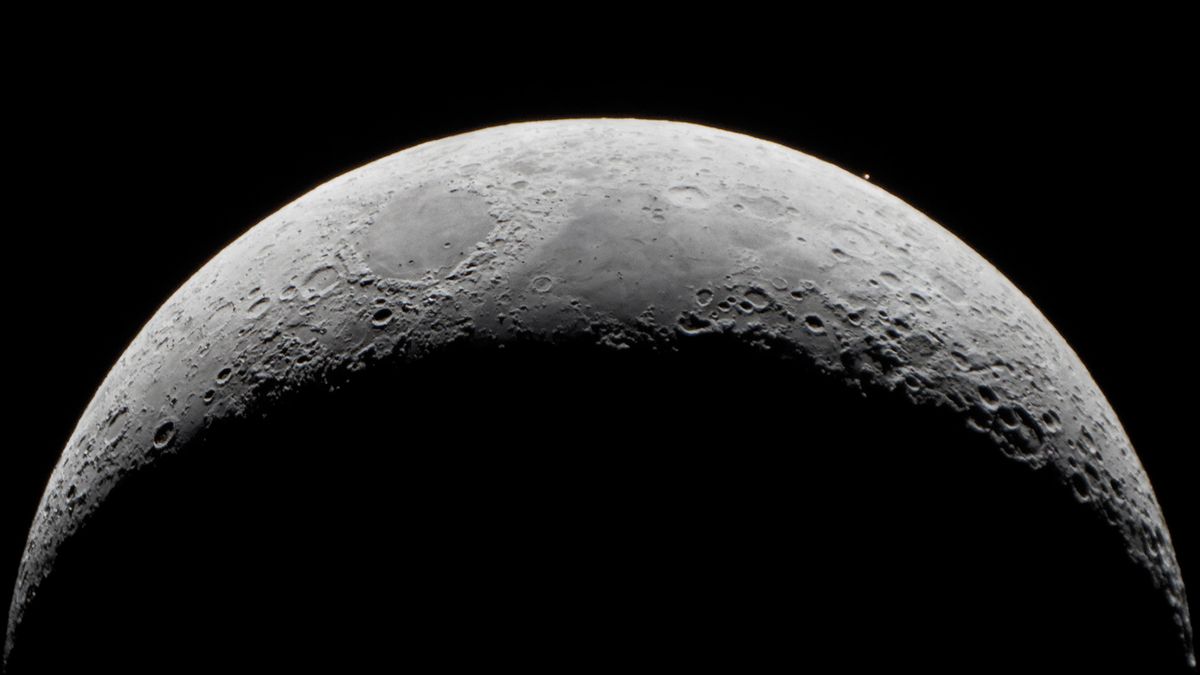
A case in point was the almost-total partial lunar eclipse we just witnessed. From where I watched, early on Aug. 28, Earth’s shadow reached its maximum across the lunar surface, covering 96.2% of it, as the moon began to sink in the west. A thin part of the lunar surface remained outside the darkest part of Earth’s shadow, and the surface never did quite go red. At maximum eclipse, the moon looked like a sliver — totally unlike a crescent moon, and something very odd to behold — and came within a fingernail of becoming a totally eclipsed “blood moon.”
Astronomy and stargazing are full of this sort of near-miss. A comet that nearly becomes bright enough to tell your neighbors about, but ultimately becomes nothing more than a smudge in binoculars that few can even find, let alone be impressed by. A meteor shower that’s hyped as the strongest for years that doesn’t live up to expectations. Or the worst kind — a cloud deck that clears a few minutes after a total solar eclipse comes to an end. We pretend these moments are failures because they do not match the headline version of the sky. But it’s often the “almost” part that keeps the imagination alive.
Beyond the headline act
A total lunar eclipse happens only when the entire moon passes into Earth’s dark umbral shadow. On Aug. 27-28, the deep partial eclipse missed totality, but the bright uneclipsed sliver made the shadow easier to see and appreciate. Its almostness gave the event an unusual tension.
During a total lunar eclipse — also called a “blood moon,” which gets headline writers very excited — the red color comes from sunlight filtering through Earth’s atmosphere. Shorter blue wavelengths scatter more efficiently, while longer red and orange wavelengths are bent into the shadow and onto the moon. In other words, the totally eclipsed moon is lit by the combined glow of sunrise and sunset around the rim of Earth. That sounds like a poetic exaggeration, but it’s just physics.
A partial lunar eclipse is equally just physics. With the headline act of totality not on the agenda, I watched Earth’s curved shadow creep across the lunar surface, almost reach across the entire orb, then gradually retreat. You could see the geometry working. You could see the moon move through a circular shadow — our planet’s shadow. A lunar eclipse always gives you time to think because it unfolds slowly, but this gave me a chance to focus on the one thing we all ignore when we obsess over the “blood moon” moment — the moon moving through Earth’s giant shadow in space.

Grazing occultations and weird eclipses
Near-misses in astronomy occur when things do not perfectly align as seen from Earth. A good example is a grazing occultation, in which the moon almost crosses a bright star or planet, but not quite. Instead of seeing it disappear and re-emerge, the planet or star winks as it’s skimmed by the mountains on the rugged edge of the moon. Spectacular examples include July 10, 2018, when red giant star Aldebaran blinked along the lunar limb, as seen from North America, and Aug. 24, 2023, when Antares played hide-and-seek behind the moon. It’s proof that the moon has no atmosphere, though it’s location-specific because the moon’s apparent position in the sky varies by about two degrees depending on where you are. There are some good occultations (which all have grazing zones) coming up:
- Sept. 8: lunar occultation of Jupiter (visible across the U.S.)
- Sept. 14: lunar occultation of Venus (visible across Europe and the Middle East)
- Sept. 17: lunar occultation of Antares (visible in southwest Australia)
However, my favorite type of celestial near-miss is a solar eclipse, which comes in so many shapes and sizes that it’s tough not to start collecting observations of them once you’ve started. If you like big partial eclipses — when the central shadow of the moon, the umbra, passes just above the planet, but never quite makes land to cause totality — get Jan. 14, 2029 and Dec. 5, 2029 in your calendar.
An extremely similar event, celestially speaking, but with a vastly different effect, will occur on April 9, 2043. On that day, a total solar eclipse will be seen from almost nowhere on the planet. Instead of a long, narrow path of totality across the globe, the cone of the moon’s dark shadow just grazes Earth’s edge. Most of the shadow misses the planet and falls into space. What does touch Earth will create an ellipse of totality over the far north of Russia. That makes it the 21st century’s sole non-central total solar eclipse. How many eclipse chasers will be in Tymlat, on the east coast of Kamchatka, for 59 seconds of totality just minutes after watching a partially eclipsed sunrise? Most will miss it for a much simpler reason — it’s not a place you can easily travel to, if at all.
Near-misses and oddities are, of course, not rare nor unusual; they’re just abnormal from our point of view during a human lifetime. Astronomy is often about being close to seeing extraordinary things without fully experiencing them, and very often it’s clouds that are to blame. If that sounds frustrating, it shouldn’t — most of life works the same way.
Stargazer’s corner: Aug. 28—Sept. 3, 2026
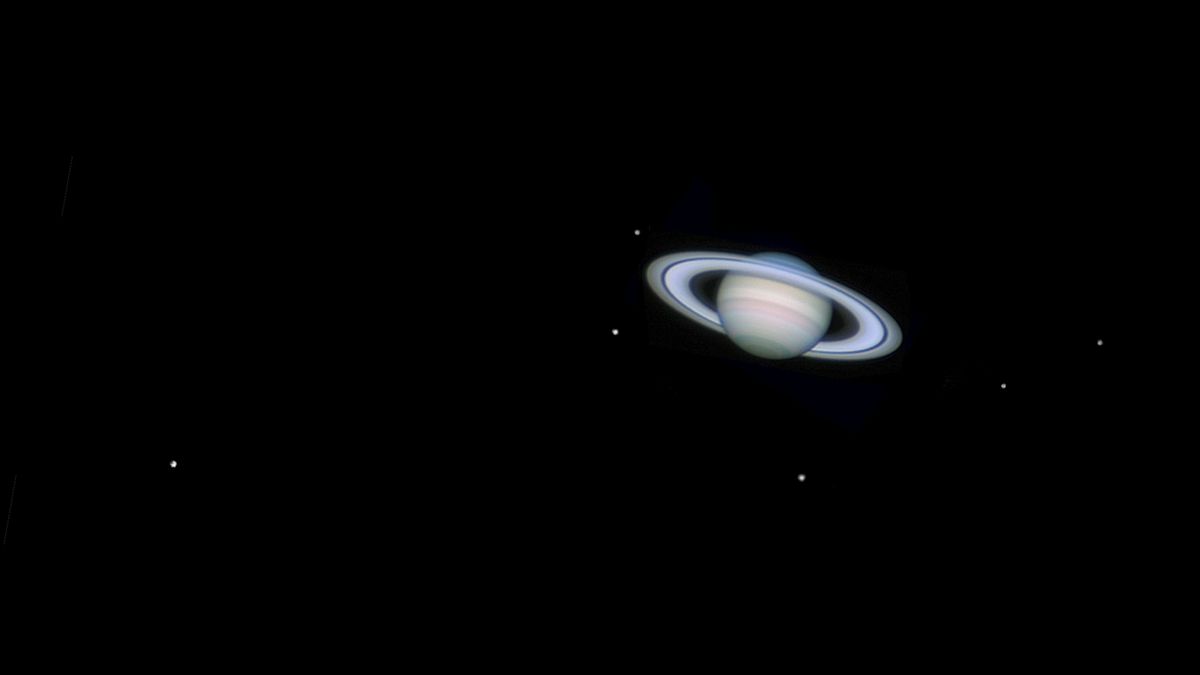
With the moon just past full, it remains bright for much of the night all week, so we’ll struggle to see galaxies, nebulae and the Milky Way. However, Saturn, rising in the east, is now becoming more convenient in the late evening sky and is worth a look through binoculars — and particularly a small telescope if you have one. It will be in conjunction with the moon on Aug. 30. Venus remains bright just after sunset, low toward the west, though horizon haze can make it less crisp than its brightness suggests.
Constellation of the week: Capricornus

Autumn is coming to the night sky. One of the telltale signs is the presence of Capricornus, a constellation that looks more convincing on a chart than in the sky. From the northern hemisphere, it sits low in the south on late summer evenings, east of Sagittarius and south of bright star Altair, the lowest star in the iconic Summer Triangle. Its stars are modestly bright, so suburban observers will need patience and a clear southern horizon. As Capricornus emerges into the evening sky, the bright center of the summer Milky Way is on the wane, beginning to lean west, and autumn is approaching.
for informational purposes only. We do not claim ownership, accuracy, or liability for the content provided. All rights belong to the original publisher.