

Who was Nancy Grace Roman? NASA’s next big space telescope is named after the ‘Mother of Hubble’
[post_content]
Disclaimer: This article has been automatically aggregated from
The Nancy Grace Roman Space Telescope is about to launch on an incredible adventure to help scientists explore the great mysteries of the universe. But who was Nancy Grace Roman?
You might have heard about the upcoming launch on Sunday morning (Aug. 30), which will send NASA’s next flagship space telescope up to investigate everything from dark matter and dark energy to far-off worlds beyond our solar system. But do you know who the telescope is named for? This observatory will be an absolute powerhouse for astronomy, and its namesake is perfectly fitting.
Nancy Grace Roman was the first-ever chief astronomer at NASA and the agency’s first female executive. She created NASA’s space astronomy program in 1959, just one year after the agency was created. She laid the groundwork for modern astronomy and played a critical role in making missions like the Hubble Space Telescope happen, a feat that earned her the nickname the “mother of Hubble.” In short, Nancy Grace Roman was a trailblazing scientist and leader whose work has made modern space science possible. But let’s dig a little deeper.
Roman’s early years
Roman was born on May 16, 1925. Her mother was a music teacher and her father was a geophysicist. Over the years, Roman would often attribute her early interest in science to influence from her parents.
“I teasingly have blamed my mother for getting me interested in astronomy, because
I can remember up in Michigan she used to take me out at night and show me the
constellations and the aurora and things like that. But she also showed me birds and
trees and animals and plants and that sort of thing, so it wasn’t just astronomy,” Roman said in a 1980 interview with David DeVorkin. That conversation took place just a few years after Hubble formally began development and a decade before the space telescope would launch (though at this time, Hubble was still called the “Large Space Telescope”).
Roman’s passion for astronomy grew, and, at age 11, she started an astronomy club with classmates. In addition to getting her friends involved in her astronomical interests, she spent her time checking out books from her local library in a quest to learn as much as she could. As she put it, she “read everything I could get my hands on.” And by junior high, Roman had already decided to become an astronomer.
“I can remember thinking, probably in junior high school or early high school days,
that I wanted to go into astronomy,” she said, adding that her parents were supportive of her early decision to study the stars.
At that time, not all colleges even allowed women to apply, so Roman had to look for a school that both accepted women and had a solid astronomy program. She eventually ended up choosing Swarthmore College in Pennsylvania, which she attended through the end of World War II. Roman would go on to graduate school at the University of Chicago, where she studied astronomy and worked at the Yerkes Observatory, where she was the first woman on the academic staff.
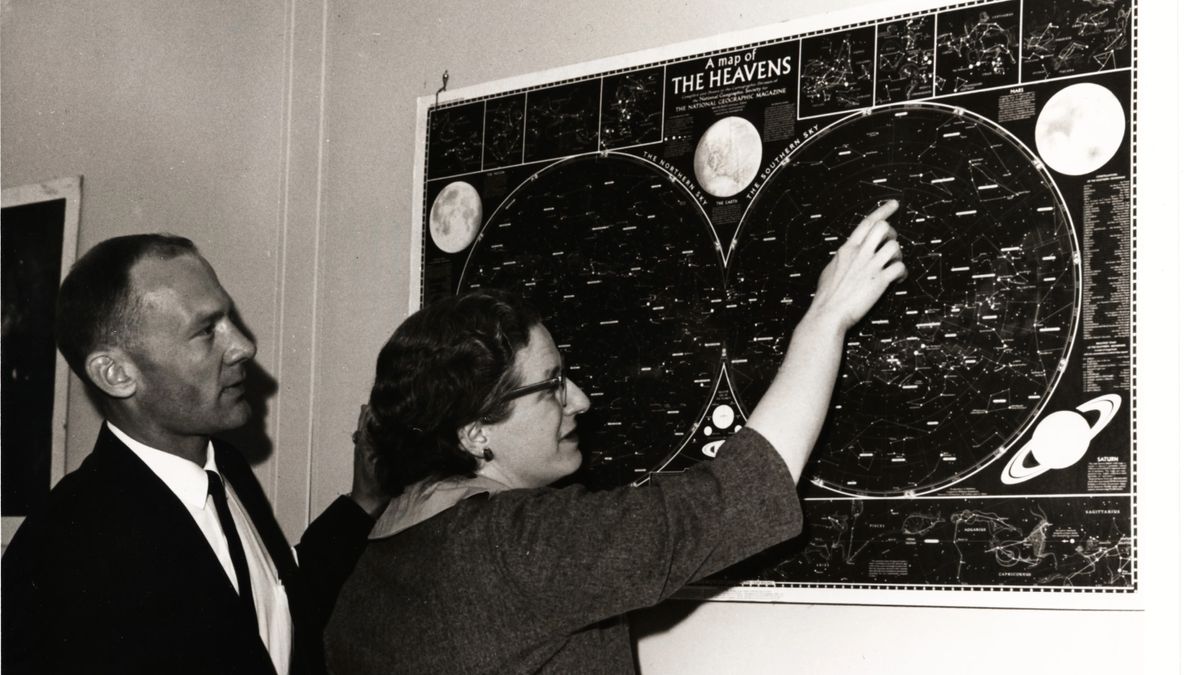
Trailblazing at NASA
After spending her early-career years at academic institutions, Roman moved on to conduct astronomy research at the U.S. Naval Research Laboratory (NRL). She was building her career observing stars and galactic structure, bouncing radar off the moon, studying orbital mechanics and so much more.
Then, in 1959, a new opportunity arose. With her expertise and experience across astronomy, and with NASA just getting up and running, Roman was asked to join the new agency and create its first astronomy program. In stepping into this role, Roman became NASA’s first-ever chief astronomer, as well as the agency’s first female executive.
“The idea of coming in with an absolutely clean slate to set up a program that I thought was likely to influence astronomy for 50 years was just a challenge that I couldn’t turn down,” Roman told DeVorkin. She added that, when she started NASA’s astronomy program, she spent a great deal of time visiting astronomy departments across the country, not just to communicate what NASA was doing but also to understand what astronomers wanted to accomplish with the agency. And it was at the 1959 American Astronomical Society meeting that Roman announced NASA’s brand-new astronomy program.
While Roman had been heavily involved in research prior to joining NASA, her role expanded considerably when she began heading the agency’s astronomy program. In addition to continuing her astronomy research outside of NASA, she was now leading NASA’s early space missions. From finding astronomers to join NASA to working alongside engineers to proposing mission budgets and navigating the many convoluted channels of a government agency to make these missions happen, Roman worked across many areas of the field to lead astronomy at the agency.
A decade after she joined NASA, Apollo 11 landed the first humans on the moon. So, as Roman pushed for progress in science, crewed spaceflight missions were taking center stage. But Roman and her colleagues fought to continue astronomy at the agency alongside crewed spaceflight. This role required her not only to be an exceptional astronomer but also to understand the political landscape both within and surrounding NASA.
Roman realized “the importance of the politics in the scientific community,” she said. “We do have to deal with it, even though we would like to make all of our decisions in a vacuum strictly on scientific and technical grounds.”
‘Mother of Hubble’
Roman had a hand in many missions, projects and research fields, and some of the work she did helped change humanity’s understanding of the cosmos. The most notable example may be the Hubble Space Telescope.
The idea for a “Large Space Telescope” (an early name for Hubble) had been around since the 1940s. But there was heavy skepticism about how feasible it would be — and also how much it would cost. Leading astronomy at NASA, Roman really had to sell the importance of this telescope to Congress to receive the funding necessary to make it happen. She pitched the project, coordinating efforts across NASA to make sure that the message landed on Capitol Hill.
“It was Nancy in the old days, before the internet and before Google and email and all that stuff, who really helped to sell the Hubble Space Telescope, organize the astronomers, who eventually convinced Congress to fund it,” Edward J. Weiler, Roman’s successor as chief scientist for Hubble, told the Voice of America in 2011.
Hubble opened our eyes to the cosmos, completely changing astronomy as we know it. The space telescope hasn’t just collected incredible data; its images have also given the general public a new appreciation for the beauty and wonder of space. And so, in making Hubble happen, Roman didn’t just advance scientific progress in astronomy; she also built an enduring bridge between the public and astronomy that continues to this day.
Roman won’t get to see her namesake telescope launch into the heavens; she died on Dec. 25, 2018 at the age of 93. But its work will continue the legacy of NASA space science that she worked so hard establish and develop.
for informational purposes only. We do not claim ownership, accuracy, or liability for the content provided. All rights belong to the original publisher.