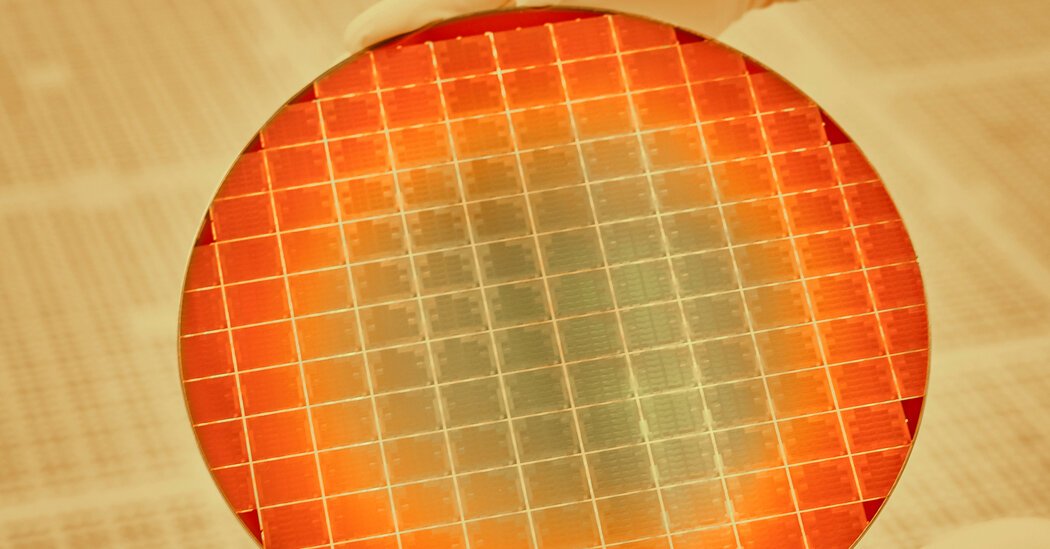
President Trump said in a social media post on Thursday that Apple was going to buy computer chips from Intel. The deal would be a significant break for Intel, the troubled Silicon Valley chipmaker that has struggled to find big customers in recent years.
While neither company has publicly discussed the deal, it would also be a notable moment for the Trump administration’s efforts to strengthen domestic chip manufacturing.
Apple is among the world’s largest buyers of semiconductors. But for more than a decade, it has made the majority of the chips that power its iPhones, Macs and other devices in Taiwan, an island that China considers a breakaway territory.
The Trump administration has been pressuring Apple to manufacture more of its technology in the United States, and it threatened to put tariffs on the semiconductors that Apple made overseas. Last year, the administration stepped up its pressure on Apple after acquiring a 10 percent stake in Intel for $8.9 billion.
“I decided to help Intel because we need to design and build our Chips right here in America,” Mr. Trump said in his social media post.
Intel declined to comment, and Apple didn’t immediately respond to requests for comment.
In his post, Mr. Trump detailed his efforts to bring the semiconductor industry “back to the U.S.A.” He said the administration helped persuade Nvidia last year to buy a $5 billion stake in Intel. It later worked with Elon Musk, the president said, to negotiate a deal with Intel to use its technology to run a chip manufacturing plant called Terafab, which Mr. Musk is developing. Finally, Mr. Trump said in his post, “Apple has agreed to work with Intel to design and build its Chips in America.”
Shares of Intel rose more than 6 percent on the news, lifting its market value to $650 billion. The company was worth about $100 billion when the U.S. government took the stake in August.
It’s unlikely that Apple will begin making chips with Intel before 2028, said Ben Bajarin, principal analyst at Creative Strategies, a tech research firm. Tech companies spend years developing chips and evaluating manufacturers before beginning to make semiconductors with them. It’s a complicated process that takes about 24 months.
Apple is expected to make a small volume of its chips with Intel, Mr. Bajarin said. The iPhone maker could rely on Intel’s factories to make semiconductors for its Mac computers first and later expand to iPhone chips.
Intel, which designs and manufactures chips that handle calculations in the majority of the world’s personal computers, lost its lead in manufacturing technology to Taiwan Semiconductor Manufacturing Company toward the end of the last decade. It also missed out on supplying processors for mobile phones and the booming market for artificial intelligence systems.
About five years ago, Intel embarked on an ambitious plan to introduce five new production processes in four years while remaking itself as a manufacturer for other chip designers, as well as producing its own products. But Intel struggled to persuade potential customers, including Apple, to work with it because the processes lagged far behind those offered by TSMC.
The market for chip manufacturing shifted over the past year as semiconductor demand surged because of the A.I. boom. TSMC has been scrambling to build new plants to satisfy the soaring demand, but it hasn’t been able to make all the chips that customers want.
Apple, TSMC’s biggest customer, has been supplanted in that role by Nvidia, the world’s leader in A.I. chips. The change gave Apple a reason to reconsider Intel, Mr. Bajarin said.
At the same time, Intel has introduced a new manufacturing process that it is beginning to sell to customers. Mr. Bajarin said the process has closed some of the gap with TSMC.
“Every manufacturer is running at full capacity, and that’s not changing,” Mr. Bajarin said. “But this is a massive validation from Apple for Intel, and that’s all it takes for customers to say, ‘If they’re going to go do it, then I should consider it, too.’”