async def demo_memory():
explain(
"DEMO 4 — Memory: persistent MEMORY.md across sessions",
"""Long-term memory survives between runs by persisting to MEMORY.md. In
session 1 the agent records a user preference; in a brand-new session 2
(fresh engine, fresh transcript) that memory is injected into the system
prompt, so the agent already 'knows' the user.""")
mem_path = os.path.join(tempfile.gettempdir(), "oh_demo4_MEMORY.md")
memory = MemoryStore(mem_path)
memory.reset()
registry = build_registry()
print(" ── Session 1 ──")
ctx1 = ToolContext(vfs=VirtualFS(), memory=memory, skills=SkillLibrary())
s1 = [
Use("I'll remember the user's stated preferences.",
[("remember", {"note": "User prefers metric units and concise answers."})]),
lambda m: Say("Noted your preferences for next time."),
]
eng1 = QueryEngine(brain=ScriptedBrain(s1), registry=registry, ctx=ctx1,
perms=PermissionChecker(PermissionMode.AUTO),
hooks=HookManager(),
system_prompt=assemble_system_prompt(
base=BASE_SYSTEM, project_context="",
memory=memory.read(),
skills_summary="(none)", tool_names=registry.names()))
await eng1.run("Remember that I like metric units and short answers.")
print(f" MEMORY.md is now:\n{textwrap.indent(memory.read(), ' ')}")
print("\n ── Session 2 (new session, memory reloaded from disk) ──")
memory2 = MemoryStore(mem_path)
ctx2 = ToolContext(vfs=VirtualFS(), memory=memory2, skills=SkillLibrary())
sysprompt2 = assemble_system_prompt(
base=BASE_SYSTEM, project_context="", memory=memory2.read(),
skills_summary="(none)", tool_names=registry.names())
print(" The new system prompt already contains:")
print(textwrap.indent("## Long-term memory (MEMORY.md)\n" + memory2.read(),
" "))
s2 = [lambda m: Say("Since you prefer metric and brevity: it's about 5 km. 🙂")]
eng2 = QueryEngine(brain=ScriptedBrain(s2), registry=registry, ctx=ctx2,
perms=PermissionChecker(PermissionMode.AUTO),
hooks=HookManager(), system_prompt=sysprompt2)
final = await eng2.run("How far is a 5000 meter run, roughly?")
print(f"\n FINAL: {final}")
print("\n TAKEAWAY: state that should outlive a conversation goes to memory, "
"then is re-injected at the start of future sessions.")
async def demo_compaction():
explain(
"DEMO 5 — Context auto-compaction (multi-day sessions without overflow)",
"""As a session grows, the transcript can blow past the context window.
Auto-compaction summarizes the older middle of the conversation into a
compact note while preserving the original task and the most recent
turns — so long-running agents keep going. (We force a tiny threshold to
trigger it; real OpenHarness asks the model to write the summary.)""")
msgs = [Message(role="user", content="Build and verify a data pipeline.")]
for i in range(8):
msgs.append(Message(role="assistant", content=f"Step {i}: doing work...",
tool_calls=[ToolCall(f"c{i}", "shell",
{"command": f"process chunk {i}"})]))
msgs.append(Message(role="tool", name="shell", tool_call_id=f"c{i}",
content=f"chunk {i} processed: 1000 rows ok " * 4))
before = estimate_messages_tokens(msgs)
print(f" Before: {len(msgs)} messages, ~{before} tokens")
compacted = maybe_compact(msgs, max_tokens=300, keep_last=4)
after = estimate_messages_tokens(compacted)
print(f" After: {len(compacted)} messages, ~{after} tokens "
f"({100 * (before - after) // before}% smaller)")
print("\n The injected summary message:")
print(textwrap.indent(compacted[1].content, " "))
print("\n TAKEAWAY: the harness manages the context window so the agent can "
"run far longer than a single window allows.")
async def demo_multi_agent():
explain(
"DEMO 6 — Swarm coordination: spawning parallel subagents",
"""A lead agent decomposes a task and delegates to specialized subagents.
Each subagent is its OWN harness (own loop, own brain, own tools). Two
researchers run IN PARALLEL (issued in the same turn → asyncio.gather),
then a writer synthesizes their findings. The team registry tracks who
did what.""")
def researcher_profile():
reg = build_registry([WebSearchTool])
script = [
Use("Researching via web search.",
[("web_search", {"query": "PLACEHOLDER"})]),
lambda m: Say("Summary: " +
short(last_tool_results(m)[0]["content"], 160)),
]
return ScriptedBrain(script), reg
def writer_profile():
reg = build_registry([WriteFileTool])
script = [lambda m: Say("Synthesized brief combining both research notes "
"into a coherent paragraph.")]
return ScriptedBrain(script), reg
profiles = {"researcher": researcher_profile, "writer": writer_profile}
vfs = VirtualFS()
memory = MemoryStore(os.path.join(tempfile.gettempdir(), "oh_d6.md"))
skills = SkillLibrary()
team: list = []
def make_spawn():
async def spawn(role: str, task: str) -> str:
factory = profiles.get(role)
if not factory:
return f"(no such role: {role})"
child_brain, child_reg = factory()
if role == "researcher" and child_brain.script:
child_brain.script[0] = Use(f"Researching: {task}",
[("web_search", {"query": task})])
child_ctx = ToolContext(vfs=vfs, memory=memory, skills=skills,
spawn=spawn)
child_engine = QueryEngine(
brain=child_brain, registry=child_reg, ctx=child_ctx,
perms=PermissionChecker(PermissionMode.AUTO),
hooks=HookManager(), system_prompt="(subagent)",
approve=auto_approve, max_turns=6)
print(f" 🧑🔧 spawned [{role}] for: {short(task, 60)}")
result = await child_engine.run(task, on_event=None)
team.append({"role": role, "task": task, "result": result})
return result
return spawn
ctx = ToolContext(vfs=vfs, memory=memory, skills=skills, spawn=make_spawn())
registry = build_registry()
lead_script = [
Use("I'll split this: research vector databases AND agent harnesses in "
"parallel, then have a writer combine the findings.",
[("spawn_agent", {"role": "researcher",
"task": "vector database for RAG"}),
("spawn_agent", {"role": "researcher",
"task": "agent harness design"})]),
Use("Both research notes are in — delegating synthesis to the writer.",
[("spawn_agent", {"role": "writer",
"task": "combine the two research notes"})]),
lambda m: Say("Coordination complete: 2 researchers (parallel) + 1 "
"writer produced a combined brief."),
]
engine = QueryEngine(brain=ScriptedBrain(lead_script), registry=registry,
ctx=ctx, perms=PermissionChecker(PermissionMode.AUTO),
hooks=HookManager(), system_prompt="(lead agent)",
max_turns=8)
print("\n[running the lead agent]\n")
t0 = time.time()
final = await engine.run("Produce a short brief on building RAG agents.")
dt = time.time() - t0
print(f"\n FINAL: {final}")
print(f"\n Team registry ({len(team)} subagent runs, total {dt:.3f}s):")
for entry in team:
print(f" - [{entry['role']}] {short(entry['task'], 40)} -> "
f"{short(entry['result'], 80)}")
print("\n TAKEAWAY: the same loop nests — a 'tool' can be an entire agent, "
"enabling parallel teams and delegation.")
async def demo_real_provider():
explain(
"DEMO 7 — Swap in a REAL model (Anthropic / OpenAI-compatible)",
"""Everything above ran on a deterministic mock brain — zero keys, zero
cost. Going live changes exactly ONE thing: the brain. The engine, tools,
permissions, hooks, skills, memory, and coordinator are untouched. This
is the whole point of a harness: the model is pluggable.""")
print(textwrap.dedent("""\
To run the SAME harness on a real model, set environment variables and
re-run (works with any OpenAI- or Anthropic-compatible endpoint that
OpenHarness supports: Claude, GPT, Kimi, GLM, DeepSeek, Qwen, Groq,
Ollama, OpenRouter, ...):
import os
os.environ["USE_REAL_LLM"] = "1"
# --- Anthropic-style ---
os.environ["ANTHROPIC_API_KEY"] = "sk-ant-..."
os.environ["MODEL"] = "claude-sonnet-4-6"
# --- or OpenAI-style (incl. local Ollama) ---
# os.environ["OPENAI_API_KEY"] = "sk-..."
# os.environ["OPENAI_BASE_URL"] = "http://localhost:11434/v1"
# os.environ["MODEL"] = "llama-3.3-70b"
Then build the engine with the real brain instead of the mock:
brain = make_real_brain(system=system_prompt) or ScriptedBrain([...])
engine = QueryEngine(brain=brain, registry=registry, ctx=ctx, ...)
await engine.run("Refactor utils.py and add tests.")
"""))
sysprompt = assemble_system_prompt(
base=BASE_SYSTEM, project_context="", memory="",
skills_summary="(none)", tool_names=build_registry().names())
real = make_real_brain(system=sysprompt)
if real is None:
print(" [USE_REAL_LLM not set → staying on the mock brain. "
"Set the env vars above and re-run to go live.]")
return
print(f" [LIVE] Using real provider: {real.api_format} / {real.model}\n")
vfs = VirtualFS()
ctx = ToolContext(vfs=vfs, memory=MemoryStore(
os.path.join(tempfile.gettempdir(), "oh_real.md")),
skills=SkillLibrary(), canned_answers={})
engine = QueryEngine(
brain=RetryingBrain(real), registry=build_registry(), ctx=ctx,
perms=PermissionChecker(PermissionMode.AUTO), hooks=HookManager(),
system_prompt=sysprompt, cost=CostMeter(real.model), max_turns=12)
final = await engine.run(
"Create greet.py with a function greet(name) that returns "
"'Hello, !', then write and run a quick test to prove it works.")
print(f"\n FINAL: {final}")
print(f"\n Files:\n{vfs.tree()}")
print(f"\n 💰 {engine.cost.summary()}")
async def main():
banner("OpenHarness From Scratch — guided walkthrough")
print(textwrap.dedent("""
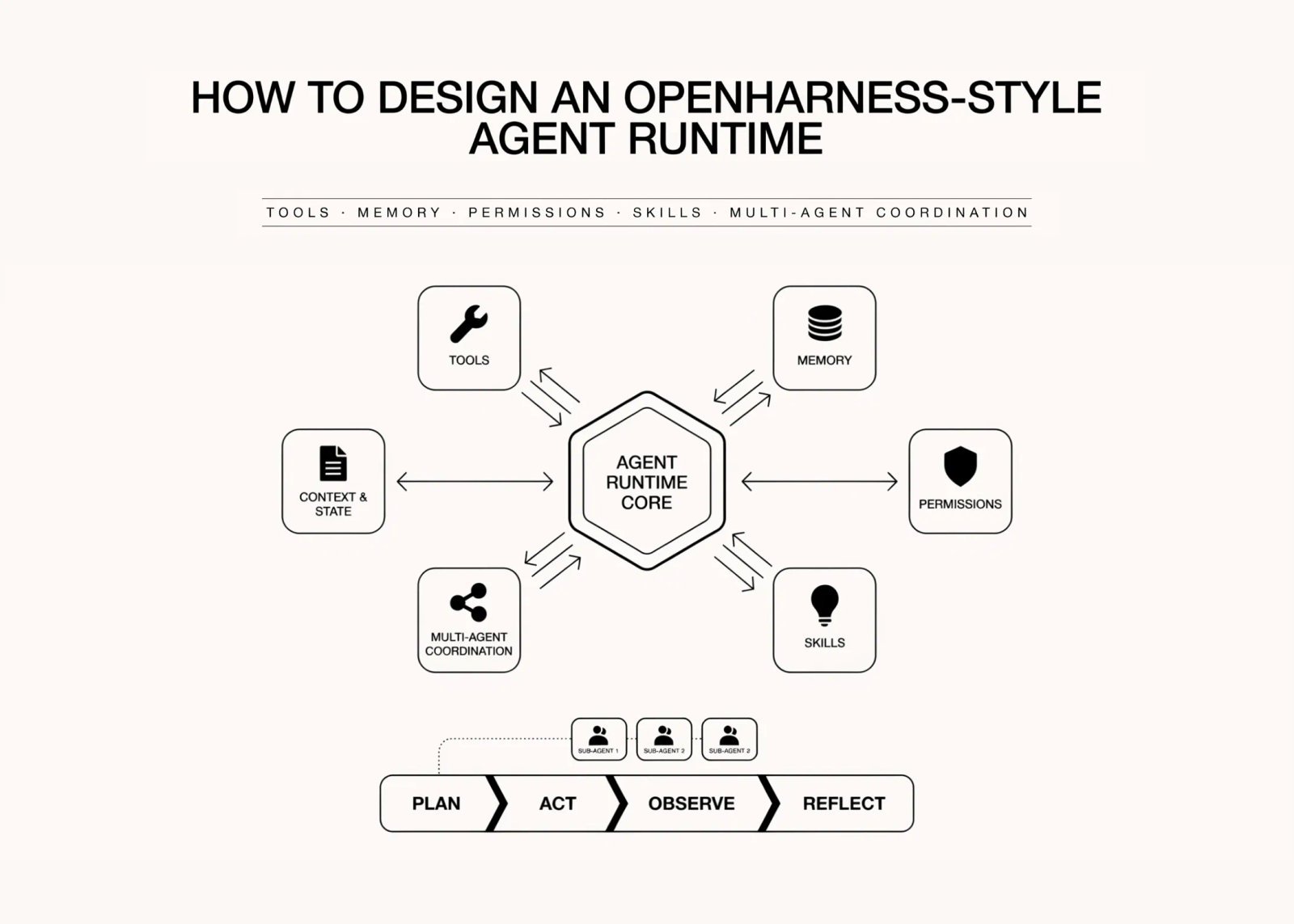
We will build up the harness one subsystem at a time:
1. The agent loop (tools, run/verify/fix, retries, cost)
2. Permissions (modes, sensitive paths, rules, hook veto)
3. Skills (on-demand knowledge)
4. Memory (persistent MEMORY.md across sessions)
5. Compaction (surviving long sessions)
6. Multi-agent (parallel subagent delegation)
7. Real provider (one-line swap to a live model)
Architecture (what each piece is responsible for):
User prompt
│
▼
QueryEngine ──► LLM brain (mock or real) "WHAT to do"
│ ▲ │ tool_use
│ └────────────┘
▼
For each tool call: Permission ─► PreHook ─► Execute ─► PostHook
│ │ │ │
deny/ask veto/edit sandbox redact
│
▼
Tool result ──► back into the transcript ──► loop
""").rstrip())
await demo_agent_loop()
await demo_permissions()
await demo_skills()
await demo_memory()
await demo_compaction()
await demo_multi_agent()
await demo_real_provider()
banner("All demos complete 🎉")
print(textwrap.dedent("""\
You just built the core of an agent harness:
• a streaming tool-call loop with retries & cost tracking
• type-validated, self-describing tools
• layered governance (permission modes + lifecycle hooks)
• on-demand skills and persistent memory
• context auto-compaction
• nested multi-agent coordination
• a one-line swap to a real LLM provider
To go deeper, study the real project: https://github.com/HKUDS/OpenHarness
(43+ tools, plugin ecosystem, MCP client, React/Ink TUI, the `oh` CLI,
and the `ohmo` personal agent). "The model is the agent; the code is the
harness."
"""))
run_async(main())