For decades, one hybrid hatchback has stood above everything else when it comes to fuel economy. Even as the market has exploded with electrified SUVs, sedans, and crossovers, no rival has managed to dethrone the long-standing benchmark for efficiency. If your number one priority is spending as little money on gas as possible, there is still one clear answer.
What makes the latest version so interesting, though, is that it no longer feels like an appliance built solely for hypermilers. Older hybrids earned a reputation for being painfully dull, sacrificing style, performance, and personality in pursuit of efficiency. That compromise has become far less severe in recent years.
The newest generation combines industry-leading fuel economy with sleek styling, a surprisingly refined cabin, and enough performance to make daily driving feel less like a chore. It still prioritizes efficiency above everything else, but it now does so without completely draining the fun out of the experience.
In order to give you the most up-to-date and accurate information possible, the data used to compile this article was sourced from various manufacturer websites, including the EPA.

There is no other new car on the market more efficient than the 2026 Prius
Industry-leading fuel savings without being too dull
For as long as it has been around, the Prius has set the benchmark for fuel efficiency. It has always been the best option on the market if the main thing you’re looking to do is reduce your gas bill. The 2026 model is no exception, beating every other new car on the market when it comes to efficiency. Unlike the Prius of yore, though, this newer model has become a little less boring.
2026 Toyota Prius fuel economy
Model | City | Highway | Combined |
|---|---|---|---|
FWD | 57 MPG | 56 MPG | 57 MPG |
AWD | 53 MPG | 54 MPG | 54 MPG |
FWD (XLE/Limited) | 52 MPG | 52 MPG | 52 MPG |
AWD (XLE/Limited) | 49 MPG | 50 MPG | 49 MPG |
With the base model achieving a whopping 57 miles per gallon combined, the Prius beats every other hybrid on the market when it comes to efficiency. The next best option is the base Elantra Hybrid, which does 53 miles per gallon at best.
Opting for all-wheel drive does reduce your overall efficiency to some degree. The XLE and Limited come with larger and heavier wheels and tires, which is why those models are slightly less efficient than the base model.
Performance specifications


- Base Trim Engine
-
2L I4 Hybrid
- Base Trim Transmission
-
2-speed CVTi-S CVT
- Base Trim Drivetrain
-
Front-Wheel Drive
- Base Trim Horsepower
-
150 HP @6000 RPM
- Base Trim Torque
-
139 lb.-ft. @ 4400 RPM
- Base Trim Fuel Economy (city/highway/combined)
-
57/56/57 MPG
- Base Trim Battery Type
-
Lithium ion (Li-ion)
- Make
-
Toyota
- Model
-
Prius
Under the hood of every Prius sits a proven, albeit slightly underwhelming, four-cylinder engine. Front-wheel drive models get two electric motors to assist the engine, with all-wheel drive models adding another to the rear. Every model comes standard with a continuously variable transmission.
We aren’t claiming this setup is anything close to sporty, but it does help to minimize the boredom the Prius nameplate has been associated with in the past. With that much power, it’s able to get up to 60 miles per hour in 7.1 seconds. It being so small also means that it is pretty nimble. The downsides come in the form of the steering, which is incredibly light and numb, and the droning caused by the CVT when accelerating.

Forget the Toyota RAV4—this Nissan SUV is cheaper and just as practical
This compact SUV gives you better fuel economy and more features than you’d expect—while still costing less than the usual go-to options.
It’s not badly priced either, competing with the likes of the Civic Hybrid
The Prius offers good bang for your buck

The Toyota brand is pretty heavily associated with quality and value, and the 2026 Prius is no different. Not only do you get the most efficient hybrid on the market, but you get something that looks nice, feels comfortable, and comes loaded with features from the get go. All of this, and Toyota has managed to keep the starting price under $30,000.
Toyota Prius trims and pricing
Models | Starting MSRP |
|---|---|
LE | $28,550 |
XLE | $31,995 |
Nightshade | $32,800 |
Limited | $35,565 |
It is true that there are a handful of hybrids in the compact car segment that undercut the Prius, such as the Hyundai Elantra Hybrid, but the Toyota just feels like a more refined option. It isn’t priced too high, though, as some of its closest rivals, like the Honda Civic Hybrid, start at around the same price, despite being less efficient.
Of the available trims, we think that the LE and the XLE offer the best value for money. The LE keeps things under the $30,000-mark and still comes with most of the features you’d want from a modern compact car. However, we think that upgrading to the LE still makes a lot of sense. For the relatively small jump in price, you’re getting things like 19-inch wheels, faux-leather upholstery, heating for the front seats, a power-adjustable driver’s seat, and a wireless smartphone charging pad, among other upgrades.

You don’t need a RAV4—this Chevy SUV is just as reliable
This used Chevy SUV proves you don’t need a Toyota to get solid long-term reliability if you pick the right one.
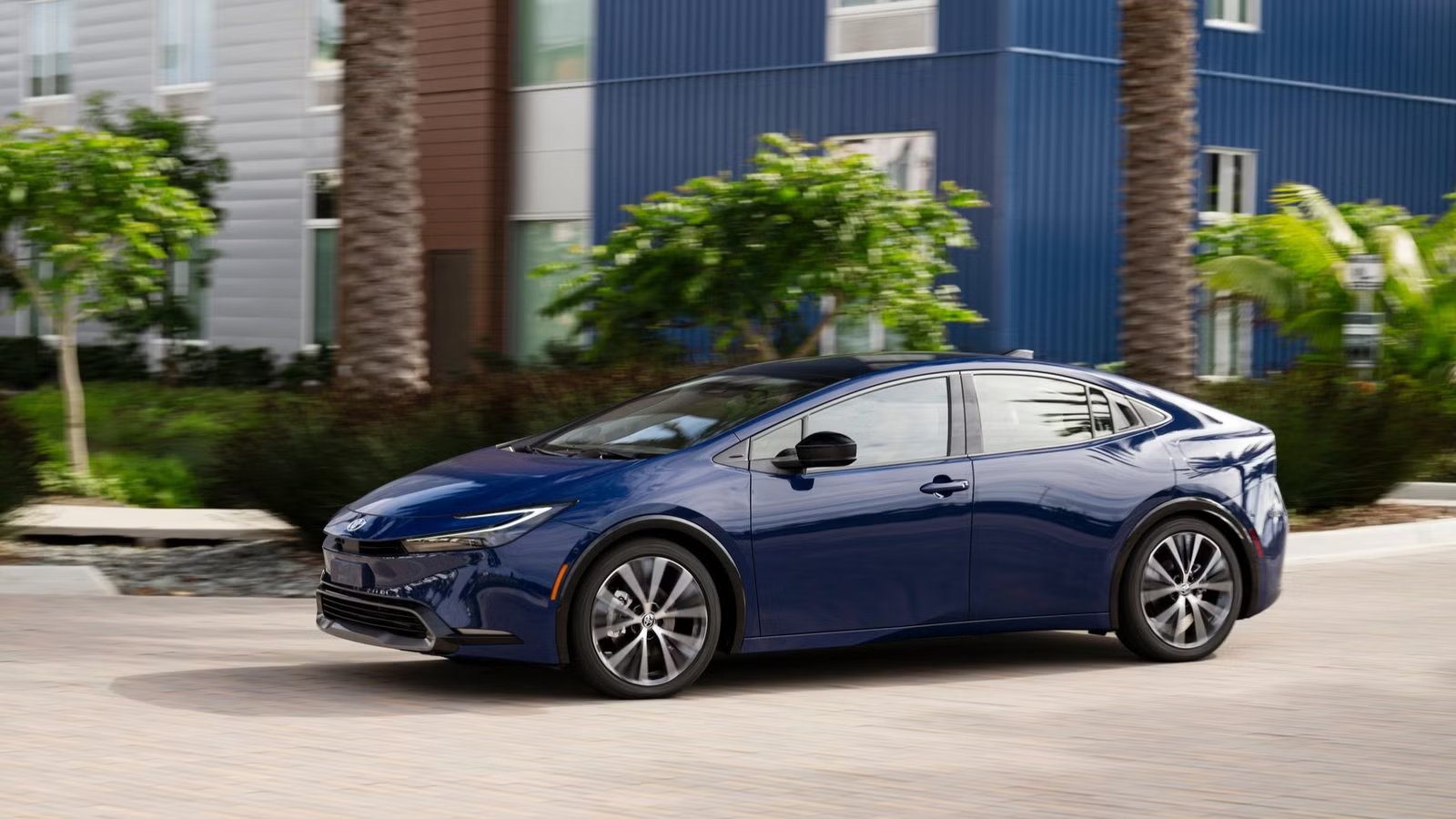
A sleek exterior and modern interior make the Prius much more appealing than it used to be
Practical, comfortable, and pretty good looking
Toyota was pretty daring when designing the exterior of the latest Prius. Rather than looking like a general econobox, it actually has some curb appeal. The interior is a little more conservative, which is a little disappointing, but it comes loaded with comforts and technology that make it easy to live with. It is also plenty practical.
Interior dimensions and comfort
Front row headroom | 38 inches |
|---|---|
Front row legroom | 43.2 inches |
Second row headroom | 36.4 inches |
Second row legroom | 34.8 inches |
Cargo capacity (behind second row) | 23.8 cubic feet |
For a compact car, the Prius is a reasonably practical option. Those in the front will have more space than they’ll likely need. Those relegated to the backseats might be a little squished, but they’ll survive without being too comfortable. The hatch opens up to reveal a pretty spacious cargo area, with more than enough space for a couple of bags or a large grocery haul.
As we already mentioned, Toyota played it a little safe with the interior of the Prius. Things are well put together and controls are easy to use, but it does feel somewhat mundane in the cabin. Base models come with necessities, while top trims get things like a fixed glass roof a power-operated tailgate, and memory functions for the driver’s seat.
Infotainment and technology
Both the LE, Nightshade, and the XLE come equipped with a standard eight-inch infotainment system mounted to the center of the dashboard. The Limited, however, comes standard with a 12.3-inch unit instead. Both the Nightshade and XLE can be optioned with the larger screen at an additional cost. We appreciate that Toyota has ditched the centrally mounted gauge display and opted for one in front of the driver instead, though you do have to adjust the steering wheel into an odd position to see it clearly.
There is no better hybrid for saving you money on gas
The Prius nameplate defined itself by being the most efficient car on the market. It’s been doing so since it became the first mass-produced hybrid back in 1997. The new model is not only better equipped, but it is also more entertaining from behind the wheel than any Prius that came before it. Not only has the Prius improved on Toyota’s mission for efficiency, but it has also become a more well-rounded car in the process.