As I write this, there are basically two types of CPU that matter: x86 and ARM. The former belongs to Intel and AMD, which each hold critical patents necessary to make modern PC chips. ARM belongs to, well, ARM, and you’ll find that in MacBooks, phones, tablets, and more.
Intel and AMD are unlikely to let anyone new make x86 chips, and ARM too is in full control of who it licenses its technology to. But, there is a third option in the form of RISC-V. Like ARM, RISC-V is a CPU instruction set architecture that uses a RISC or “Reduced Instruction Set Computer” approach. However, unlike ARM (and x86), RISC-V is completely open. Anyone can design and sell RISC-V CPUs without paying a cent.
Why RISC-V matters
It’s the principle that counts
The world runs on microchips. These little squares of thinking sand are immensely important, and having just two closed architectures dominating everything is a good thing. However, it’s important to remember that RISC-V isn’t a CPU you can just buy from someone. It’s a “blueprint” you can use to design your own CPU.
Because that blueprint is free and open, it means you can extend it, build on it, and create exactly what you need without having to reinvent the wheel.
The easiest comparison is the difference between Linux and Windows. Linux gave developers an open foundation they could modify freely, which allowed innovation to happen at every level of the stack. RISC-V aims to do something similar for silicon.

- Storage
-
SD card slot
- CPU
-
StarFive JH7110
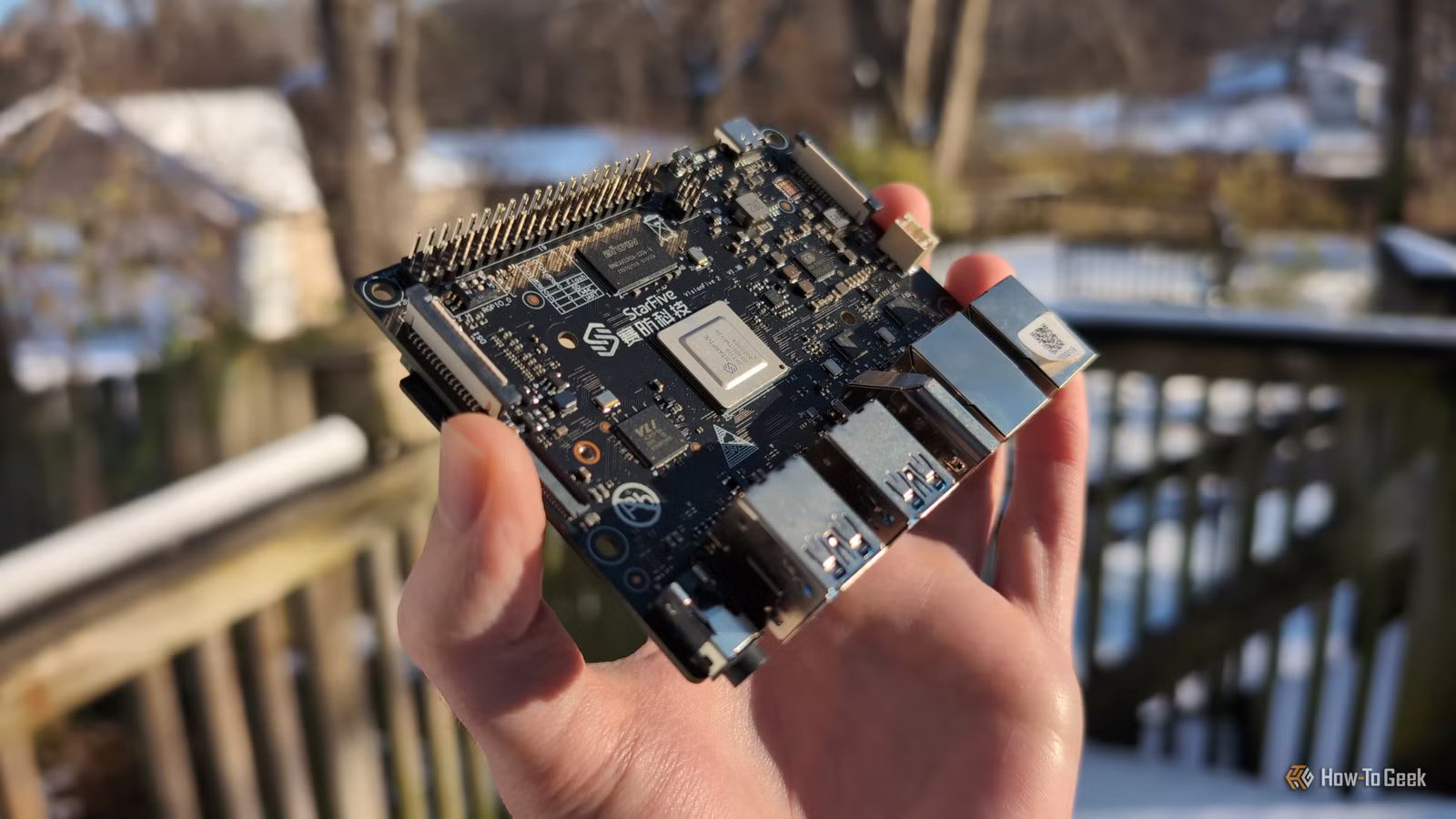
This single board computer kit features the StarFive JH7110, an open source RISC-V U74 quad-core processor. It also has a GPU that can hit 600Mhz for graphics processing, and multiple ports and pins for connectivity and experimenting.
Hardware has always lacked a “Linux moment”
A much harder door to open

As soon as the open source movement took off for software, we saw an explosion in innovation. Today, most of the world’s infrastructure runs on open source software, such as the Linux kernel. While creating a CPU isn’t as fast and easy as writing some code, the hope is that RISC-V will also lead to a similar innovation.
Now anyone can contribute to and refine a chip’s design. Security flaws can be found sooner or avoided. New innovations in efficiency and performance could be possible with so many brains working on the problem. It also creates the potential for more hardware developers, since the artificial barriers against entering the hardware design industry are removed.
The companies betting big on RISC-V
Interesting how much “free” costs, isn’t it?

What started out as a niche academic project to prove a point has now become serious business. Seeing the potential benefits, big companies like Google and NVIDIA are investing in RISC-V.
The appeal is obvious. Companies increasingly want more control over their hardware stacks, especially in an era dominated by AI workloads and custom silicon. There’s also a political angle. Countries around the world are looking for alternatives to technologies controlled by foreign corporations or governments. Because RISC-V is open, it’s viewed by some as a way to reduce dependence on U.S.-controlled intellectual property ecosystems.
Ironically, the US is also concerned about hardware manufacturing being outside the USA. Which is why the CHIPS Act exists. If less manufacturing of x86 chips will be happening in places like Taiwan, then perhaps those facilities will eventually pump out some future more mature version of RISC-V instead.
What an open hardware future could look like
More transparency, less time in the dark
If RISC-V actually gains momentum, then eventually we could be looking at a very different world, technologically speaking. Smart home devices, routers, and numerous other appliances that rely on licensed processors today could be switched over to RISC-V.
This hardware could be audited for things like hardware backdoors, and if the designs are open it means more competition and lower prices. At least in theory.
The reasons RISC-V still might not become “the Linux of hardware”
This all sounds good on paper, but RISC-V has a long and uncertain road ahead. Just look at how long it took for ARM CPUs to get a foothold, and it’s not like RISC-V is the first pretender to the crown.
The main issue is that even if the architecture is free, making chips is far from it. So RISC-V is still going to be in the hands of massive capital concentration. It’s simply the name of the game when chip fabs cost billions. The second major issue is software compatibility. ARM and x86 have that locked in, although in the modern age of computing, translation layer technology has become exceedingly efficient and there’s already RISC-V Linux. This is why RISC-V is most likely to get its proper start with embedded systems like routers or other smart devices, where software compatibility is a non-issue. It’s probably going to be a long time before you’ll be reading this on a RISC-V laptop or smartphone.