
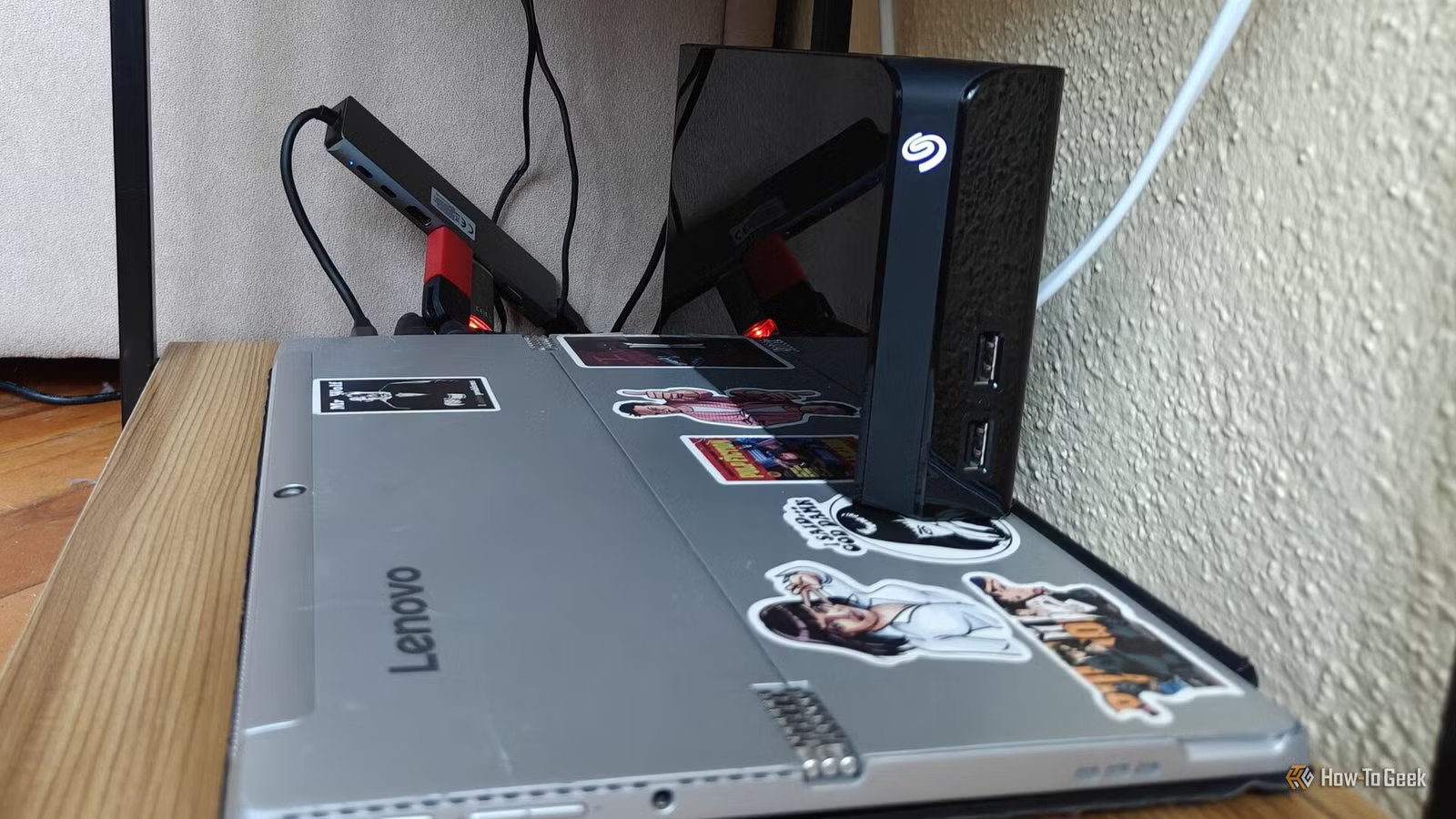
Everyone says the battery is the best part of a laptop-turned-NAS: Here’s why I unplugged mine
One of the biggest advantages of turning a laptop into a NAS is that you get to fully reuse its internals, including the built-in battery. In the event of a power outage, that battery can keep the system running until electricity returns, effectively serving as a mini-UPS. This allows zero downtime and no need to reset or reconfigure anything, which is especially useful if your NAS is in a hard-to-reach spot like mine.
However, a recent event completely changed how I viewed this old battery, prompting me to immediately tear my laptop open and unplug it. If you’ve got a laptop running as a NAS 24/7, I suggest doing the same, and here’s why.
A laptop battery feels like the perfect built-in UPS for a DIY NAS
A built-in safety net that seems too good not to use
The most important reason you’d want your NAS to have a UPS is data integrity. A NAS that’s running 24/7 is constantly moving data between RAM and the storage drives, and it’s syncing data across multiple devices.
When power is abruptly cut mid-write, you risk corrupted files, file system errors, or a partially written or inconsistent filesystem that the NAS can’t properly recover on reboot. If you’re running older drives, you might even end up with a volume that refuses to mount.
Since a UPS is essentially a battery (with additional voltage regulation and protection circuitry), it’s easy to draw a parallel and use a laptop’s internal battery as a makeshift UPS. It can either keep the system running through a short outage or at least give it enough time to shut down cleanly.
 Quiz
QuizUnique and creative DIY NAS setups
Trivia challenge
From old laptops to dusty routers — find out how well you know the wild world of homemade network storage.
HardwareNetworkingSoftwareDIY BuildsStorage
Which major advantage makes an old laptop a surprisingly good candidate for a DIY NAS build?
Correct! A laptop’s built-in battery acts like a mini UPS (uninterruptible power supply), protecting your data from sudden power outages. This is a significant perk that desktop-based NAS builds don’t get for free.
Not quite. The big hidden advantage of a laptop NAS is its built-in battery, which functions as a natural UPS. This keeps the system running briefly during power cuts, protecting data integrity without any extra hardware.
Which open-source firmware is most commonly flashed onto compatible routers to enable NAS-like USB storage sharing features?
Correct! OpenWrt is a Linux-based open-source firmware that replaces stock router firmware and adds powerful features, including USB storage sharing via Samba or NFS, turning a basic router into a lightweight NAS.
Not quite. OpenWrt is the go-to open-source firmware for repurposing routers. Once flashed, it supports USB drives connected to the router’s USB port, enabling basic NAS functionality like Samba file sharing on a very small budget.
Which NAS operating system is specifically designed to run well on low-power ARM-based single-board computers like the Raspberry Pi?
Correct! OpenMediaVault (OMV) is a Debian-based NAS OS that supports ARM architectures, making it a popular choice for Raspberry Pi NAS builds. It’s lightweight, free, and has a web-based GUI that simplifies setup.
Not quite. OpenMediaVault is the answer. Unlike TrueNAS or Unraid, OMV is optimized to run on ARM processors, which is why it’s the community favorite for Raspberry Pi-powered NAS projects.
When building a NAS using a Raspberry Pi, what is the most common bottleneck that limits file transfer speeds?
Correct! On older Raspberry Pi models (prior to the Pi 4), both the USB ports and the Ethernet port shared the same USB 2.0 bus, creating a significant bottleneck when transferring data between network and storage simultaneously.
Not quite. The real culprit on older Raspberry Pi models is the shared USB and Ethernet bus. Because both the network adapter and USB storage competed for the same bandwidth, real-world NAS speeds were often far below what the hardware theoretically promised.
What is a ‘Franken-NAS’ commonly referred to in DIY storage communities?
Correct! A ‘Franken-NAS’ is a beloved DIY term for a NAS cobbled together from spare and salvaged parts — old desktop cases, mixed hard drives, and recycled motherboards all stitched together into one functional (if ugly) storage machine.
Not quite. A Franken-NAS refers to a storage build assembled from mismatched, salvaged components — think old desktop parts, second-hand drives, and whatever case happens to fit. It’s a badge of honor in the DIY NAS community.
Which RAID level is recommended for a small 2-drive DIY NAS that prioritizes data redundancy over total storage capacity?
Correct! RAID 1 mirrors data identically across two drives, meaning if one drive fails, your data survives on the other. It cuts your total usable capacity in half but provides simple, reliable redundancy — perfect for a two-drive home NAS.
Not quite. RAID 1 is the right answer for a two-drive redundancy setup. RAID 0 stripes data for speed but has zero redundancy, and RAID 5 or 6 require three or more drives. RAID 1 mirrors your data across both drives for straightforward protection.
What protocol do most DIY NAS builders configure to allow Windows PCs on the local network to browse shared folders like a network drive?
Correct! Samba implements the SMB (Server Message Block) protocol on Linux and Unix systems, enabling seamless file sharing with Windows machines. It’s the standard choice for home NAS builds because Windows natively understands SMB shares.
Not quite. Samba, which uses the SMB protocol, is the standard answer here. It allows Linux-based NAS systems to present their shares in a way Windows PCs understand natively, so you can map them as network drives without any extra client software.
Which low-power x86 platform became extremely popular for DIY NAS and home server builds due to its fanless design and efficient Intel Atom or Celeron processors?
Correct! Compact Chinese-manufactured mini PC boards from brands like Topton and Cwwk, featuring Intel’s N100 or N5105 processors, became hugely popular in the DIY NAS community around 2022–2024. They offer multiple 2.5GbE ports, low power draw, and multiple SATA connections at a very low price.
Not quite. The Topton and Cwwk N100-based mini PC motherboards became a community favorite for budget DIY NAS builds. They pack multiple Ethernet ports, SATA connections, and efficient modern CPUs into a tiny, affordable package that traditional options couldn’t match at the price.
Your Score
/ 8
Thanks for playing!
When I first set up my laptop NAS, I experienced a blackout, and when power came back on, it just continued to work. I was genuinely relieved at the time, especially since I was still new to Linux and had no idea how I’d recover or reconfigure everything if it had shut down. Since then, I’ve built proper configuration files that persist after reboot, but back then, it saved me from quite a bit of frustration.
So, in practice, that means fewer recovery steps and a much lower chance of having to fix your NAS after a blackout. It sounds like a free upgrade with no downsides, right?
In practice, running the laptop NAS off the battery means fewer recovery steps and a much lower chance of having to fix your NAS after a blackout. It sounds like a free upgrade with no downsides, right?

- Brand
-
CyberPower
- Load
-
400W
800VA provides enough juice to keep your NAS powered until you’ve had a chance to shut it down gently. Plus, there’s surge protection and an AVR at a low cost.
Constantly keeping a laptop’s aging battery always at 95–100% is risky
Keeping a device with a battery always plugged in isn’t as harmless as it looks
Jordan Gloor \/ How-To Geek<\/p>\n””>

Jordan Gloor / How-To Geek
If you’re running your DIY laptop NAS off a brand-new laptop, there’s a very low chance that something will go wrong. Laptops, new and old, constantly monitor battery charge and have fail-safes that prevent it from overcharging to a dangerous level. They typically keep the battery between 95–100%, so in the event of a blackout, the laptop can continue running for a while.
However, the problem with older laptops is that aging lithium-ion batteries develop higher internal resistance (impedance), which makes it harder for the system to estimate the actual battery charge. Moreover, charging a high-impedance battery causes more energy to be lost as heat, especially when the battery is mostly full.
Without getting too into the weeds, as this aging battery continues to experience constant heat and charging cycles, it eventually starts to swell—and this is exactly when this “built-in UPS” turns into a real fire hazard that techies humorously refer to as “spicy pillows.”
The pressure inside the battery builds up, and it’s further exacerbated by the hard shell of a laptop that leaves no room for it to expand. It eventually becomes so great that it can lead to thermal runaway, where gases are released, and the battery ignites, producing large amounts of heat and toxic fumes.
You probably don’t need me to tell you why something like this happening in a NAS that’s running 24/7—even when you’re not home to catch it early—can become an extremely dangerous fire hazard.
To be clear, I’m not trying to scare you here by sounding like an alarmist. The chances of this happening are still very low, even with an older laptop, but it’s something to be aware of, especially if your battery is already showing signs of swelling.

What pushed me to disconnect the battery in my NAS laptop
Something drastic happened, which made me rethink my setup

While I was aware of the very real risks that old lithium-ion batteries carry, I didn’t think much of it when I repurposed my old laptop from 2016 to run as a 24/7 NAS. I’d opened up the laptop to change the thermal paste before repurposing it, and the battery showed no signs of swelling.
I figured there would be warning signs like random shutdowns and bulging in the laptop case long before it became a concern.
However, when my mom’s old phone randomly caught fire one morning, with virtually no warning signs, my view of lithium-ion batteries changed completely. As much as I appreciated having that UPS-adjacent power backup built into my laptop, I just couldn’t risk leaving it running with the battery constantly charging and discharging, especially since there are times when nobody is home for much of the day.
So after that incident, I immediately shut down my laptop NAS, opened it up, and disconnected the battery internally.

I confirmed that the laptop could run off AC power by plugging it in and booting it, and my battery-free laptop was off to the races. It’s still inside the laptop, but it will slowly lose charge over time. Since it’s no longer constantly charging, it should remain stable.
A proper UPS is the only real solution if you want to be safe
It’s the only real solution
My laptop’s firmware doesn’t allow me to limit the battery charge to a certain percentage. Many newer laptops can do that, so if you want to keep using the battery as a UPS, you could cap the maximum charge at around 60%. This alone makes it safer because the battery is no longer being kept at full capacity, which means less stored energy if something goes wrong.
However, even though it reduces the risk, it’s still not zero. The battery will still generate heat over time, which accelerates chemical degradation. Besides, the battery only helps during blackouts—it won’t protect your laptop’s internals or the sensitive external drives connected to it. Only a proper UPS can do that, which is why it’s the better solution if you want your NAS to stay online while also protecting it from voltage spikes.

Please stop running your home NAS without a UPS (it’s not just about power outages)
Don’t subject your data to the worst silent killer for electronics.