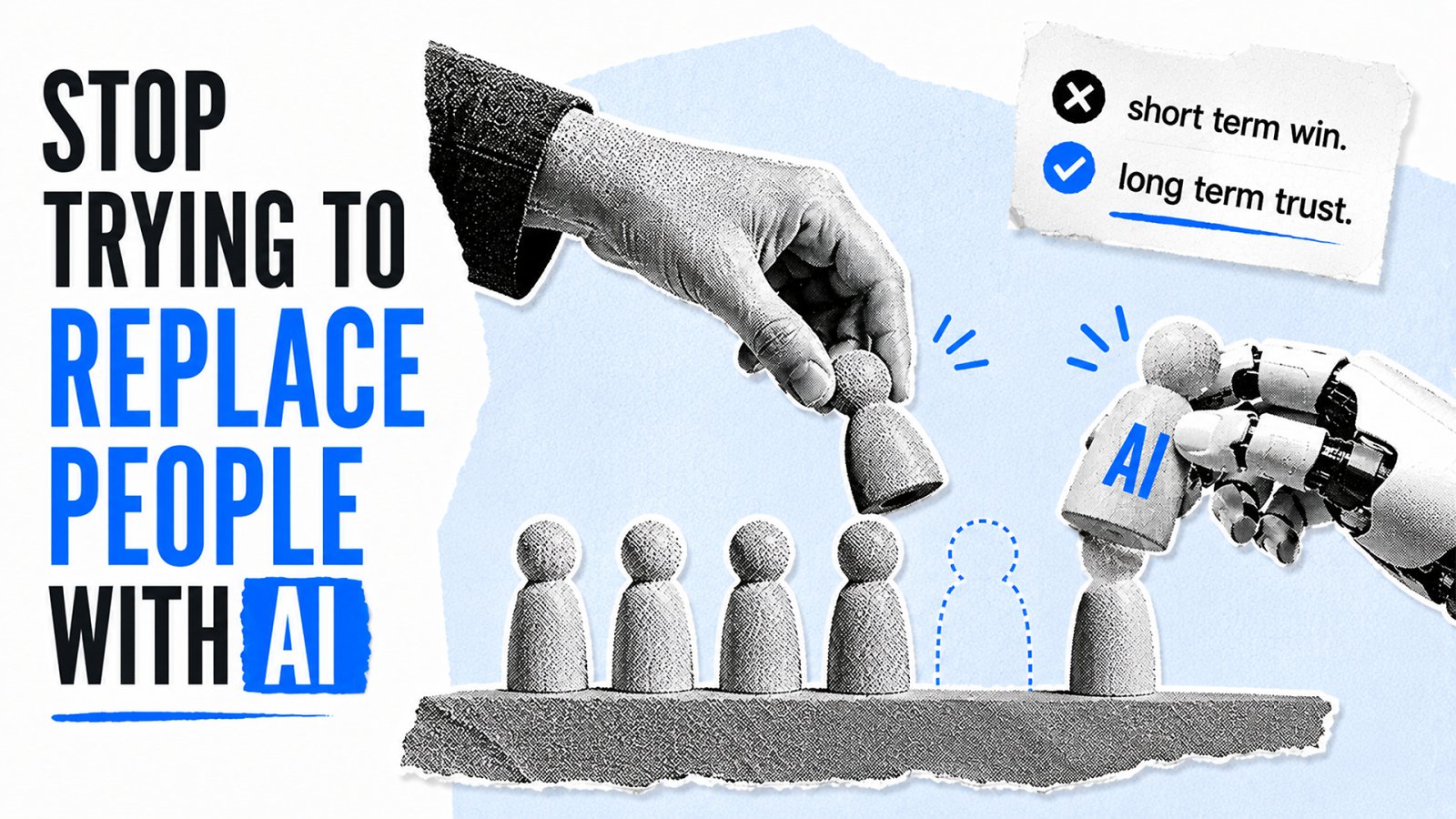
The biggest positioning mistake in AI marketing is selling your product as a replacement for people. It wins attention now, but costs you trust later.
Heads up: This memo is a slight deviation from the usual topics I regularly write about. But it’s an important one.
In this memo:
- Why “substitution positioning” feels good short term and decays your brand long term.
- The data showing AI isn’t actually replacing people.
- How to better position AI.
The cardinal sin of positioning in the AI era is replacement. I call it “substitution positioning.” Short term, it’s yummy. Long term, it plants cavities in your perception.
In January, Anthropic CEO Dario Amodei predicted software engineering jobs to go away in the following 6-12 months. Demand for software engineers is reaching new heights today.
“I think we might be 6 to 12 months away from when the model is doing most, maybe all of what SWEs do end to end.”


In September 2025, OpenAI CEO Sam Altman predicted customer support jobs will go away. Almost immediately after he said that, customer service hiring started outpacing the broader job market.
- “I’m confident that a lot of current customer support that happens over a phone or computer, those people will lose their jobs, and that’ll be better done by an AI.”

AI companies use fear as a marketing tool. Specifically, the fear of being replaced. They got me, too. I was deeply worried about my future when Opus 4.5 got traction.
However, as long as I see that even Anthropic is hiring copywriters and SEOs, I sleep much better.
Times were more uncertain before AI came on the scene (I’ll spare you the TED talk about unprecedented times). Fear sells. Tapping into our primal fight-or-flight response is a sure way to get attention. And layoffs act as a double agent in this environment: They make companies that underperform or overhired look good (“Look, we don’t need as many people anymore because we’re so innovative!”) and feed the substitution positioning narrative.
But the facts show that recent layoffs are closer to AI washing than AI spring cleaning:
- New York state added an option for companies to indicate when they lay staff off due to AI (technological innovation or automation). In March of this year, over 160 companies filed mass layoffs of ~28,300 workers. Not even one chose AI as the reason. That list includes Amazon and Goldman Sachs.
- Researchers at Yale looked at the CPS, a government survey that tracks employment across the US, over the last 33 months and found no evidence of job displacement from AI. The way AI impact works looks very similar to how computers and the internet changed work.
Premium is $150/year. That’s less than one walked-back AI announcement. The Growth Memo resource library includes the positioning reframe asset in this memo… and the rest of the audits, workflows, and decks built for the AI visibility era.


“Stop trying to make ‘replacement’ happen. It’s not going to happen.”
— Regina George from Mean Girls in an alternate multiverse
AI is just not there… yet.
Synthetic intelligence in its current form is heavily paradoxical: AI can do some things better than humans and others not even at the level of a chimpanzee.
This phenomenon is called the Jagged Frontier. It’s based on a paper where BCG and Harvard researchers conducted a randomized controlled trial of 758 knowledge workers and found that you get the most (12.2% more tasks, 25.1% faster) out of AI if you know what it’s good and bad at.
That’s why some people are lukewarm on AI and others see it as new salvation.
“Currently, measures of exposure, automation, and augmentation show no sign of being related to changes in employment or unemployment.”
— From “Evaluating the Impact of AI on the Labor Market: Current State of Affairs,” Gimbel et al.
Microsoft came to the same conclusion. In its 2026 Work Trend Index Annual Report, the Windows mother found that ~16% of the 20,000 AI users surveyed are “Frontier Professionals” or the most advanced AI users in the research set who use agents for multi-step workflow systems.
80% of those Frontier Professionals said they produce work they couldn’t have a year ago, compared to 58% across the board. They are not just using AI more, but also know which mode a task calls for. They have the judgment to navigate the Jagged Frontier.


Caption: Microsoft’s 4 modes of using AI at work
Despite some of the gains you can see from AI, we’re far away from replacing people.
Do you truly trust any AI workflow enough to leave it on full automation without any maintenance or quality assurance?
Look at a company that tried: Klarna publicly bragged its AI did the work of 700 agents and cut headcount ~40%, Then they reversed and rehired humans after the CEO admitted cost-cutting produced “lower quality” and that customers want a human option.
As a result, choosing substitution positioning means you gain short-term attention but sacrifice long-term credibility. Anthropic calls for a public pause on AI development on June 4 and launches Fable 5 on June 9. OpenAI did the same: Altman told the U.S. Senate in May 2023 that AI needs licensing and a global watchdog, then opposed binding rules and lobbied against California’s SB-1047 and mandatory federal pre-launch approval. The words don’t match the actions.
Substitute positioning could work if customers (1) actually wanted the replacement and (2) if the technology was there. Neither are true.
FYI: The Adapting for AI-Based Search deck gives directors a validated, data-backed story to present to executives who keep asking what changed. Find it in the Premium Subscribers Resource Library.
Antagonism
Cost reduction is a much stronger AI-use argument than productivity growth because it hits the P&L immediately. Productivity gains show up later. They build slowly inside a company and even slower across the economy, the same lag we saw with computers and the internet.
However, because replacement positioning goes way beyond just cost-cutting (it’s people-cutting), you also directly antagonize the people you sell to:
In April, Uber execs bragged about burning their annual token budget in just four months. Today, that’s a massive liability. Token cost is growing despite being heavily subsidized. But soon, it will reach a price point that makes junior employees start to look interesting again.
Entry-level jobs might soon be cheaper than tokens accomplishing the same output, and young people don’t have the same baggage and reflexes that experienced experts have.
What is the replacement for ‘replacement’?
Instead of trying to replace people, the solution is to position your AI use as enhancement. The opposite of fear-based marketing is aspiration and empowerment.
AI goes both ways: You can reduce the number of people or grow output with the same number of people. And the data shows that productivity gains have a higher ROI than substitution.


In a paper by the National Bureau of Economic Research, Researchers asked 750 executives about the impact of AI on productivity and labor markets. While larger firms have a higher interest in replacing labor cost (people), the highest ROI comes from growing productivity.
The moral of the story? Doing more with what you have works better than firing copywriter Alex because only Alex can judge good copy.


Premium: Your positioning matters more than ever + Claude skill
Building products has gotten easier, but distribution has not.
When supply explodes, the scarce thing is being the product that actually gets chosen, and positioning (right alongside product quality) is exactly how you get chosen.
Premium subscribers get the Claude skill that performs a quality check on your content’s positioning for any AI-based tooling within your product, offering quality reframes for your team that avoid substitution positioning.
This post first appeared on the author’s website and is republished here with permission.
Contributing authors are invited to create content for Search Engine Land and are chosen for their expertise and contribution to the search community. Our contributors work under the oversight of the editorial staff and contributions are checked for quality and relevance to our readers. Search Engine Land is owned by Semrush. Contributor was not asked to make any direct or indirect mentions of Semrush. The opinions they express are their own.