America Online merged with Time Warner in 2001 in a deal worth $165 billion. This year, what remains of AOL was sold to an Italian company called Bending Spoons for $1.5 billion.
The most surprising part is not that AOL is still alive and making $633 million a year, but that it is about to go public alongside a stable of other aging internet brands.
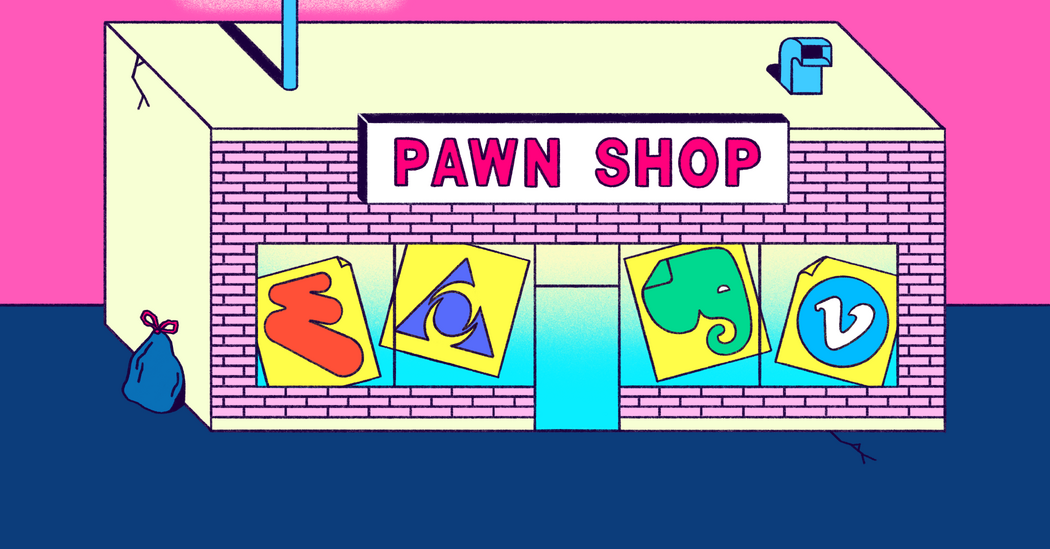
Bending Spoons, AOL’s new owner, has been buying older tech companies, many with familiar names like Evernote, Vimeo, WeTransfer, Brightcove and Eventbrite. This week, the company plans to raise as much as $1.62 billion in an initial public offering on the Nasdaq stock exchange that could value it as high as $19 billion.
Bending Spoons’ strategy is far from the frenzied swirl around hot, highly valued companies building artificial intelligence. The A.I. boom has turbocharged expectations of success in an industry that was already obsessed with the new and next, leading to a series of blockbuster I.P.O.s. Elon Musk’s SpaceX recently broke records with its $1.77 trillion listing, and investors are eagerly anticipating the market debuts of Anthropic and OpenAI.
Companies no longer on a rocket ship of hypergrowth are typically left behind in that narrative. But Bending Spoons is showing there is still value to be had in old internet names. The company’s playbook often involves quickly cutting employees who worked on the internet services, raising prices and then dispatching its army of young, Milan-based engineers to improve the products to kick-start growth.
“Our idea is to be a hybrid between a private equity firm and Google,” Luca Ferrari, Bending Spoons’ chief executive, said in a 2024 interview. “It’s like they had a baby.”
(Mr. Ferrari declined to comment for this article, citing the quiet period ahead of its listing.)
Bending Spoons is not the only firm chasing tech’s castoffs. Constellation Software, a Canadian company with $11.6 billion in annual revenue, specializes in buying business-oriented software and technology companies. A Los Angeles company called MediaLab, run by Michael Heyward, the founder of the anonymous social media app Whisper, has bought the assets of Imgur, the image-sharing site; Kik, the messaging app; and Genius, the music lyrics site.
Since it was founded in 2013, Bending Spoons has purchased more than 50 companies. Last year it generated $1.3 billion in revenue and swung to a net loss of around $200,000. Its strategy has angered some former employees and customers, who say the internet companies were doing fine before Bending Spoons came along and gutted them.
Mr. Ferrari said in 2024 that his company makes drastic, sometimes painful changes to the businesses it buys, all in service of improving them. “If someone wants to see nothing change, we’re not a good buyer,” he said.
At the moment, Bending Spoons has a bounty of potential deals. Traditional software stocks have taken a beating as investors fear A.I. disruption, and many venture capital investors have shifted their focus to artificial intelligence. That leaves a generation of start-ups and tech companies that began before the A.I. boom with fewer options. Bending Spoons has a list of more than 1,000 potential acquisitions, it said in its I.P.O. filing.
“These are not walking dead companies,” said Joe Hyrkin, who sold his company, Issuu, a digital publishing platform, to Bending Spoons in 2024. They are simply no longer of interest to venture capital investors, he added.
Kerry Trainor, founder of Creator Partners, an investment firm that backed Bending Spoons in 2022, said well-known brands, even from the digital era, had a deeper connection to audiences than people might think. Some brands will be replaced by artificial intelligence, he noted, but plenty of others will simply adapt.
“The markets often over-rotate toward thinking everything will be replaced,” he said.
Bending Spoons grew out of a failed digital diary app that Mr. Ferrari founded with some engineer pals in 2010. The app, Evertale, flopped.
The group decided to use its leftover cash and engineering skills to spruce up digital products that had already found an audience, paying $10,000 to buy a digital keyboard app and using the profits from that to buy more apps. It named its holding company after the idea of “bending spoons with the mind,” a concept popularized by a scene in “The Matrix.”
Eventually Bending Spoons’ deals became big enough that the company raised outside funding and took on debt to keep buying.
Bending Spoons’ growth has attracted tech talent to Milan. The company puts young, inexperienced people with “high potential,” known as “Spooners,” in positions of major responsibility, according to its filing. Last year, it hired 286 people out of 800,000 applications, it said.
Sriram Krishnan, an investor at the venture capital firm Kearny Jackson, met Bending Spoons’ founders in 2022. He invested and offered to introduce the founders to his network of contacts. But most of them were skeptical of Bending Spoons, he said.
That year, Bending Spoons bought the note-taking app Evernote. Founded in 2004, Evernote was one of the first app companies to take off alongside the rise of smartphones. It was so beloved in Silicon Valley that fans would show up at the company’s headquarters to peruse the gift shop in its lobby. But over time, its growth slowed, and it cycled through a string of failed turnarounds.
Bending Spoons’ deal to acquire Evernote grabbed the tech industry’s attention. The Spooners quickly shuttered Evernote’s Silicon Valley office, laid off most of the staff and changed the app’s pricing. They also upgraded the app’s technology, added features and attracted new users. That led to a revenue increase for its first two years of ownership, before revenue declined slightly last year.
Suddenly, Mr. Krishnan said, venture capitalists wanted introductions to Bending Spoons. The A.I. boom was picking up steam, and many of them discovered they had aging companies that needed to sell.
“The tides turned very quickly,” he said.
Bending Spoons continued buying well-known U.S. start-ups, including the event company MeetUp, the file sharing company WeTransfer and the online video service Brightcove.
When Mr. Hyrkin decided to sell Issuu, the digital publishing company founded in 2006, he was concerned that a buyer might leave its customers stranded. He appreciated Bending Spoons’ promise to never sell its properties.
Mr. Hyrkin knew Bending Spoons was likely to cut most of Issuu’s 150 employees and negotiated for bigger severance and ample warning as part of the “low nine figure” deal, he said.
Bending Spoons later upgraded some of Issuu’s tools and eliminated a pricing plan, pushing customers to a more expensive pricing tier with more features. Mr. Hyrken said he had wanted to make similar changes as chief executive, but felt he could not because it might have jeopardized certain milestones that potential investors or acquirers cared about.
When Bending Spoons bought the livestreaming service StreamYard in 2024, the company’s employees were devastated. Nic Taylor, a former StreamYard product manager, said he had thought he would work there for many years — maybe even the rest of his career.
“I used to go to conventions in a StreamYard T-shirt and people would genuinely want to hug you,” he said. Most were laid off after the sale. Geige Vandentop, one of StreamYard’s founders, said in a statement that watching Bending Spoons cut staff, raise prices and upset users had been “brutal.”
So when Bending Spoons bought the video-hosting service Vimeo the next year, Mr. Taylor and the StreamYard founders saw an opportunity to push back. Vimeo’s customers were speculating that the service might raise its prices. StreamYard’s founders poured $10 million into a new video hosting company called Livid, which offers a free tool to let people migrate their video libraries off Vimeo. “Vimeo makes leaving hard,” Livid declared. Its tool has been downloaded more than 10,000 times to export a quarter of a million videos, the company said.
In September, AOL shut down its dial-up internet service, first released in 1989. The company now makes money selling ads and membership subscriptions for things like malware protection and tech support to its 30 million monthly users. The next month, Bending Spoons announced it would buy AOL from its private equity owner for $1.5 billion, its largest deal yet.
In a statement at the time, Mr. Ferrari praised AOL as an “iconic, beloved business that’s in good health.”
Soon after the deal closed in January, the layoffs began.