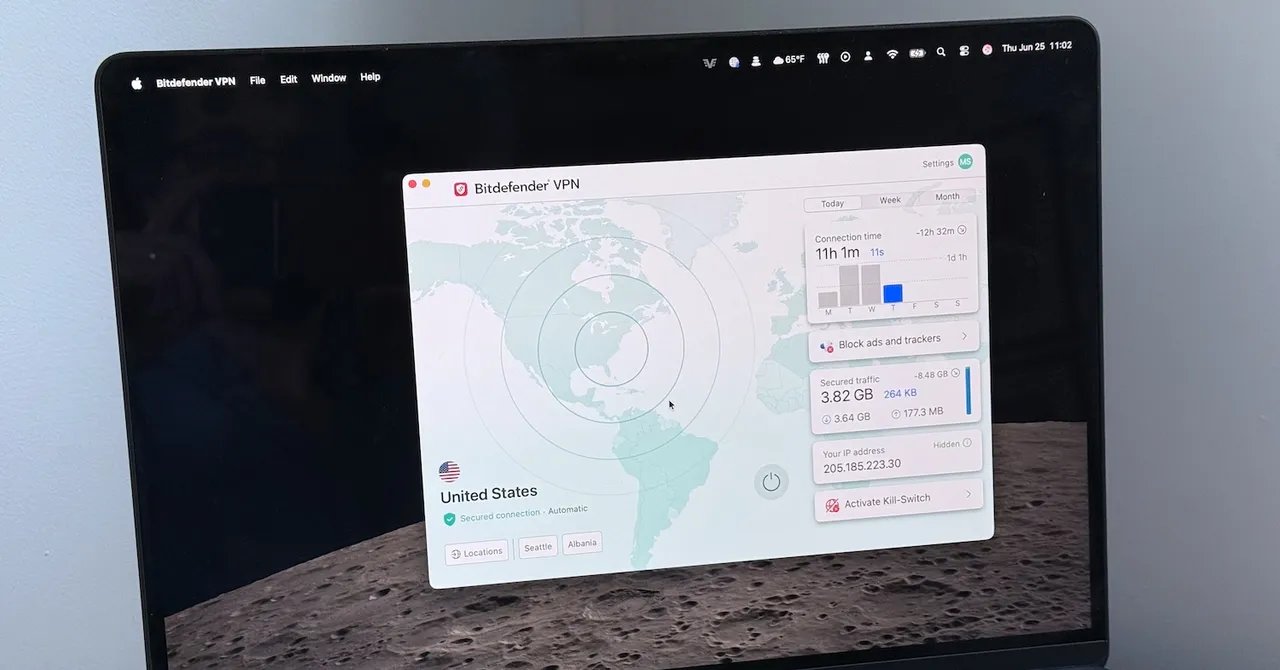
Bitdefender VPN was reliable in my time using it, as well. I didn’t experience any connection drop-outs or periods of unusually slow performance.
These are solid results, though not the best. For example, I saw slightly better speeds (up to 540 Mbps, the same as when not connected to the VPN) while using IVPN with the WireGuard protocol enabled, for example.
Still, Bitdefender is plenty fast, very reliable, and I can’t say I found the gap in performance noticeable outside of in particular testing. I expect that most people will find the data rates provided by Bitdefender VPN to be more than adequate.
Privacy Promises and Compromises
Unlike Mullvad, a privacy-pilled alternative that positions itself as a tool against mass surveillance, Bitdefender VPN focuses more on avoiding geo-restrictions, ads, cookies, tracking, and Wi-Fi sniffing. There’s nothing wrong with that approach, but if you want a service that puts the P in VPN, you should look elsewhere.
Bitdefender’s VPN is provided through a partnership with IPVanish. IPVanish provides the infrastructure, while Bitdefender provides the client software, branding, customer service, and so on. It’s worth mentioning, as IPVanish took a reputation hit back in 2018 when it handed user logs to the US Department of Homeland Security. This occurred in 2016 and happened despite having a no-logs policy.
However, IPVanish ownership has exchanged hands several times since then, and it’s now owned by media company Ziff Davis. IPVanish has undergone a number of successful independent, no-log audits, the most recent of which occurred in 2025. IPVanish also publishes a transparency report showing the volume of requests it has received from law enforcement and the data it has provided in response.
That’s good news, but wrinkles remain. IPVanish is a US company, and US law is pretty strict when it comes to law enforcement demands for data. IPVanish can’t provide what it doesn’t log, but privacy nerds often prefer VPN companies in less draconian jurisdictions.
It’s also unclear how Bitdefender’s service interact with IPVanish’s no-logs policy. Bitdefender obviously retains at least some information about the user, because a Bitdefender account is required to use the VPN, and users have to pay with a credit card. Bitdefender has some customer service information about its no-log policy, but the specific wording means this could be referring to the IPVanish audit.
Whether any of this matters depends on what privacy means to you. If you want an extra layer of network security to ward against trackers and prevent issues on compromised Wi-Fi connections, then Bitdefender VPN will do the job. However, Bitdefender VPN isn’t going to meet your needs if you’re worried about nation-state tracking or want to move across the web in near secrecy.
Conclusion
Bitdefender’s VPN is an easy-to-use service that works best for people with basic expectations for what a VPN should offer. It provides typical features and delivers solid network performance at a competitive price. It’s not the ultimate VPN for privacy and it’s lacking a few features some people will want, like Linux support and a static IP option.
Pricing might push you toward Bitdefender VPN—at least for the first year. The introductory offer of $35 for a year of service is an outstanding value. Just remember to check pricing again before it’s time to renew, as Bitdefender’s pricing after the first year is less enticing.