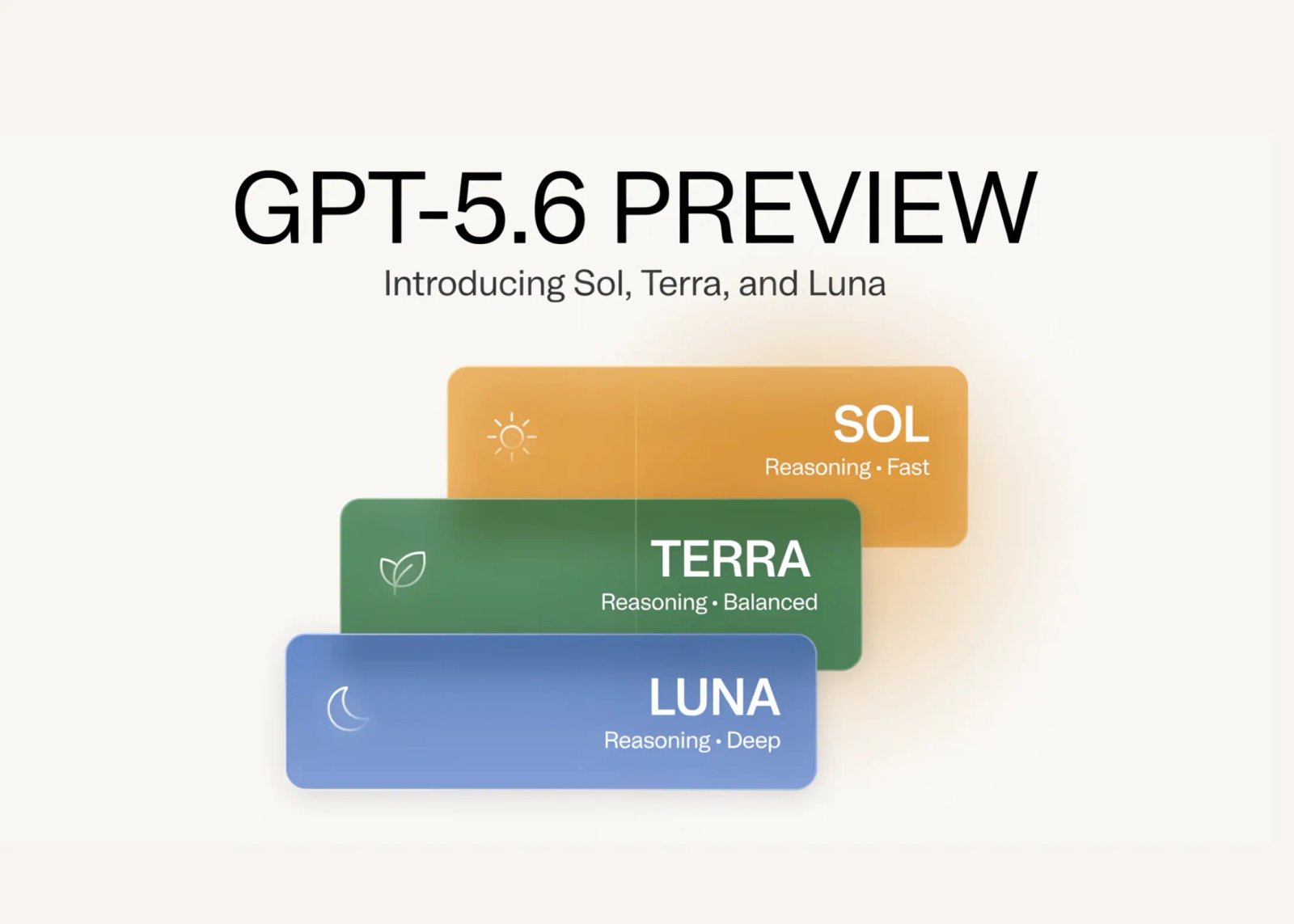
OpenAI has begun a limited preview of GPT-5.6, its next-generation model series. The lineup splits into three named tiers: Sol, Terra, and Luna. Sol is the flagship. Terra targets everyday production work. Luna is the fast, low-cost option.
OpenAI is starting with a small group of trusted partners through the API and Codex. According to OpenAI post, they shared the models and plans with the U.S. government first. Broader access in ChatGPT, Codex, and the API is planned in the coming weeks.
The change is mostly structural. GPT-5.6 introduces tiered models, two new reasoning modes, and a heavier safety stack.
What is GPT-5.6?
GPT-5.6 is a family, not a single model. OpenAI also changed how it names releases. The number now marks the generation. The names mark durable capability tiers.
Each tier can advance on its own schedule. That gives developers a clearer choice across intelligence, speed, and cost.
OpenAI calls Sol its strongest model yet. It cites gains in coding, biology, and cybersecurity. Terra matches GPT-5.5 performance while costing roughly half as much. Luna brings strong capability at OpenAI’s lowest price.
New Reasoning Modes: max and ultra
GPT-5.6 adds two reasoning controls. The first is a new max reasoning effort. It gives Sol the most time to reason deeply.
The second is ultra mode. Instead of one model working alone, ultra leverages subagents. These subagents split complex work to accelerate it.
Think of it this way. The max setting deepens a single chain of reasoning. The ultra mode coordinates several workers on one task. Both trade latency and cost for accuracy on long-horizon problems.
Interactive Explainer

GPT-5.6 Family Explorer
Compare Sol, Terra, and Luna. Estimate cost, scan benchmarks, and see the new reasoning modes. Illustrative tool using OpenAI’s published preview pricing and figures.
Tiers
Cost Calculator
Benchmarks
Reasoning Modes
Sol flagship
Strongest tier. Built for long-horizon coding, security, and agentic work.
$5/ 1M input $30/ 1M output
Terra balanced
Matches GPT-5.5 performance at roughly half the price. For everyday production.
$2.50/ 1M input $15/ 1M output
Luna fast
Lowest cost. For routine, high-volume, latency-sensitive tasks.
$1/ 1M input $6/ 1M output
Naming: the number marks the generation; Sol, Terra, and Luna mark durable capability tiers that advance on their own cadence.
Assume 50% of input is cached (90% read discount)
Estimated monthly cost
Sol
$0
Terra
$0
Luna
$0
Estimate only. Excludes reasoning-token overhead from max/ultra, taxes, and rate tiers. Cache writes bill at 1.25x input.
Terminal-Bench 2.1 tests command-line workflows needing planning, iteration, and tool coordination. Scores per VentureBeat’s reading of OpenAI’s charts; ultra uses subagents, max is single-agent deep reasoning.
max
A new reasoning effort that gives Sol the most time to reason deeply. One model, one longer chain of thought.
in
→
think
→
think
→
out
ultra
Goes beyond a single agent. It leverages subagents that split complex work and run it in parallel.
task
→
sub 1
sub 2
sub 3
→
merge
Both modes trade latency and cost for accuracy on long-horizon problems. Available in the GPT-5.6 preview.
Preview access: ~20 partners via API & Codex. Broader release planned soon.
Built by Marktechpost
Cookie Consent
We use cookies to improve your experience on our site. By using our site, you consent to cookies.
Contains information related to marketing campaigns of the user. These are shared with Google AdWords / Google Ads when the Google Ads and Google Analytics accounts are linked together.
90 days
__utma
ID used to identify users and sessions
2 years after last activity
__utmt
Used to monitor number of Google Analytics server requests
10 minutes
__utmb
Used to distinguish new sessions and visits. This cookie is set when the GA.js javascript library is loaded and there is no existing __utmb cookie. The cookie is updated every time data is sent to the Google Analytics server.
30 minutes after last activity
__utmc
Used only with old Urchin versions of Google Analytics and not with GA.js. Was used to distinguish between new sessions and visits at the end of a session.
End of session (browser)
__utmz
Contains information about the traffic source or campaign that directed user to the website. The cookie is set when the GA.js javascript is loaded and updated when data is sent to the Google Anaytics server
6 months after last activity
__utmv
Contains custom information set by the web developer via the _setCustomVar method in Google Analytics. This cookie is updated every time new data is sent to the Google Analytics server.
2 years after last activity
__utmx
Used to determine whether a user is included in an A / B or Multivariate test.
18 months
_ga
ID used to identify users
2 years
_gali
Used by Google Analytics to determine which links on a page are being clicked
30 seconds
_ga_
ID used to identify users
2 years
_gid
ID used to identify users for 24 hours after last activity
24 hours
_gat
Used to monitor number of Google Analytics server requests when using Google Tag Manager