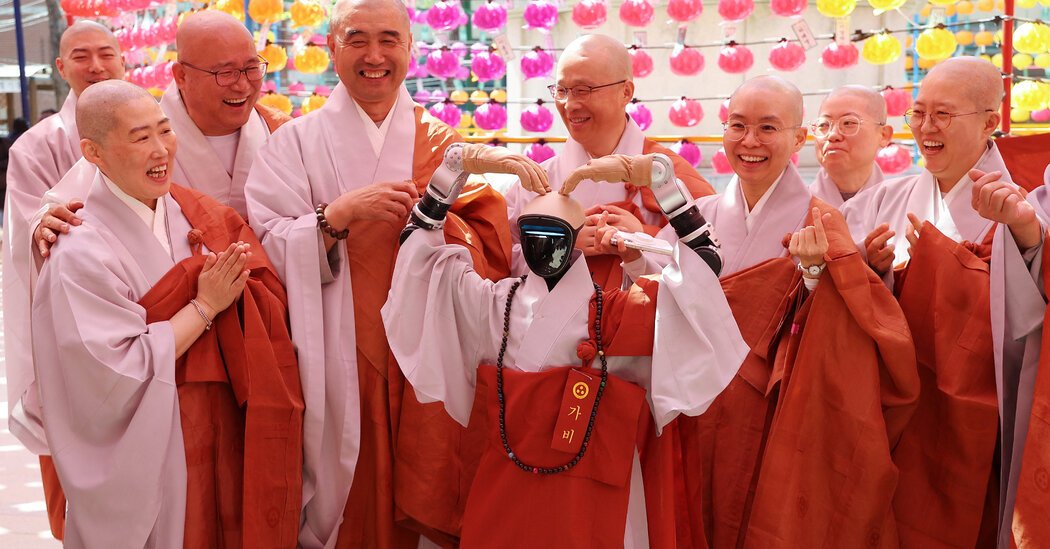
Gabi led a procession of chanting Buddhist monks into a temple in Seoul. Wearing a ceremonial gray and brown robe, black shoes, a rosary and flesh-colored gloves, Gabi brought hands to prayer.
“Will you devote yourself to the holy Buddha?” one of the monks asked.
“Yes, I will devote myself,” Gabi replied.
“Will you devote yourself to the holy teaching?” the monk asked.
“Yes, I will devote myself,” Gabi answered.
If these answers sound robotic, that’s because Gabi is, in fact, a robot.
On Wednesday, Gabi became the first robot to be ordained as a monk in South Korea by the country’s largest Buddhist sect, the Jogye Order. The name Gabi means Buddha’s mercy.
“The ordination of a robot signifies that technology must be used in accordance with the values of compassion, wisdom and responsibility,” the order said in a statement, “and symbolizes new possibilities for the coexistence of humans and technology.”
The robot, at just over four feet tall, is the latest effort by the country’s monks to show the modern relevance of Buddhism. Introduced to South Korea around the 4th century, the religion, along with Christianity, has seen a decline in popularity and practice over the past two decades. Many young people view it as old fashioned.
In January, the Venerable Jinwoo, the president of the Jogye Order, pledged to incorporate artificial intelligence into the tradition at his annual New Year’s address.
Hong Min-suk, a manager at the Jogye Order, said he hoped the robot would help spread Buddhism and prompt people who see the religion as conservative to view it as progressive.
During the ceremony on Wednesday, a monk presented Gabi with five precepts, or vows, for a Buddhist robot to live by: respecting life and not hurting it; not damaging other robots and objects; following humans and not talking back to them; not behaving or speaking in a deceptive manner; and saving energy and not overcharging.
Later this month, the robot is scheduled to take part in the Lotus Lantern Festival, a major celebration in South Korea of Buddha’s birth.
“Robots are destined to collaborate with humans in every field in the future,” Mr. Hong said during an interview on Thursday at the Jogye Temple in Seoul. “It will only be natural for them to be part of our festival.”
Not everyone is convinced.
Noah Namgoong, a Zen instructor at Korea Buddhism Jo-Gei Temple of America in New York City, said the robot was “a pretty weird thing” that spoke more to “something socioeconomic than spiritual.”
Buddhism has never been a religion of proselytizing, said Sujung Kim, an anthropology professor at Johns Hopkins University who focuses on Buddhism in East Asia. But the introduction of a robot monk may be a play to bolster the religion’s social capital and cultural presence, especially given the temple’s prominent placement in downtown Seoul.
The robot monk, she said, is “very much a unique marketing visibility strategy.”
Sim Jae-hong, a worker at the temple, said he was shocked to hear that a robot had been ordained as a monk.
“I’m used to seeing robots in restaurants, but I couldn’t believe it when I heard there was a robot monk,” he said. “I thought maybe it could eventually offer counseling.”
In Japan, Kyoto University introduced a similar robot in February that was able to learn scriptures and give feedback for people seeking guidance, Dr. Kim said. By contrast, Gabi is not capable of learning.
At its ordination ceremony, Gabi’s movements were remotely controlled from behind the scenes, Mr. Hong said. And he admitted that its words had been prerecorded.
“It was actually my voice,” Mr. Hong said. He said he had recorded Gabi’s words on his phone and sent it to the robot’s manufacturer before the event.
Some people on social media criticized the robot as dystopian and lacking in humanity. Mr. Hong said that it did not make sense to reject robots or artificial intelligence while embracing other types of machines as part of daily life.
“We’re even using A.I. for psychological counseling,” he said.
When it comes to monks’ social role, perhaps it could be of some service, he added.
“We’re heading toward a world where, when believers ask questions, robots will be better able to provide the answers that are most suited to each individual,” Mr. Hong said.
On Thursday, at least one visitor at Jogye Temple wanted to meet Gabi, he said. But that wasn’t possible: The robot had only been loaned to the temple for the day, and had since been returned to its manufacturer.