Keyword research can be hard, and in local search it’s a different beast in 2026. As we analyze the most significant local SEO trends 2026 has brought us, it’s clear that the gap between Google’s two primary data ecosystems—Search Console and Google Business Profile (GBP) Performance—is wider than ever.
When you’re working with small businesses, you are often dealing with limited data pools. Many popular keyword tools still show zero volume or fail to account for hyper-local nuances, so we often default to Google’s own ecosystems. In the local world, there are two main sources for this: Search Console and Google Business Profile (GBP) Performance. I wanted to see how these tools stack up today and if they’re still telling the same story.
TL;DR;
- The Gap is Real: 66% of the top 10 keyword lists for Search Console vs. GBP Performance are different.
- Users vs. Impressions: GBP reflects unique users, while Search Console reports impressions (which are often bot-inflated).
- The Mobile Blindspot: Search Console cannot track Local Pack impressions if the “Website” button isn’t shown—a trend increasing with AI Overviews.
- UTM Tagging is Mandatory: Without UTMs, you cannot separate local and organic results in Search Console.
GSC vs. GBP Performance – Our Data Gathering Methodology
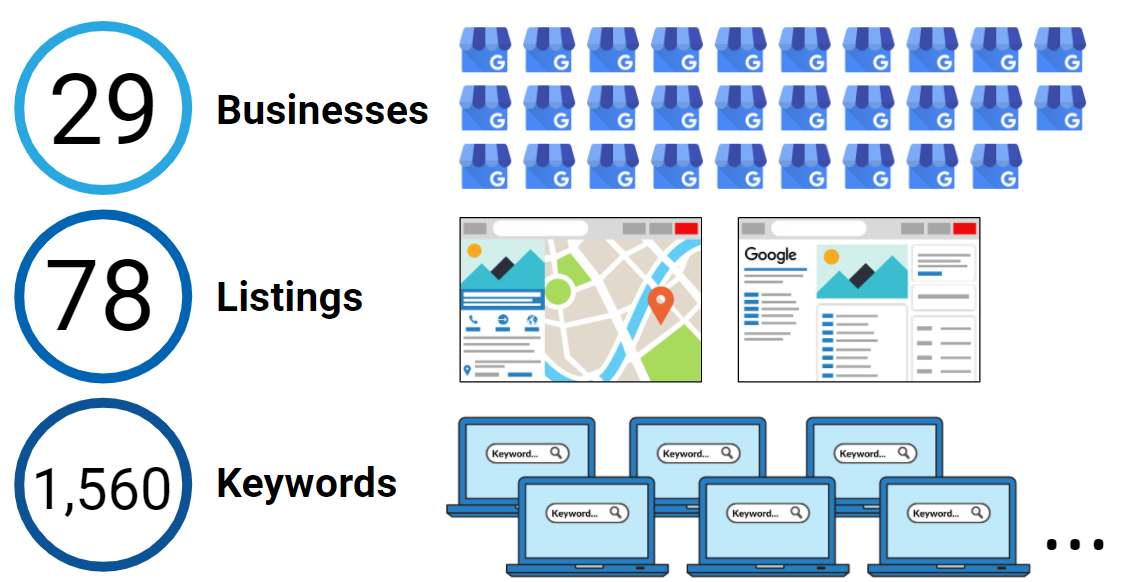
For this study, we analyzed 78 different Google Business Profiles across 29 businesses. We compared the top 10 queries inside Search Console against the “Searches” data in the GBP Performance dashboard.

Using UTM filters in Search Console is the only way to isolate local pack data accurately.
To ensure accuracy in Search Console, we filtered our data to only include pages containing our UTM codes. Using UTMs is the only way to truly separate Local Pack traffic from standard organic traffic in your reports. We then categorized every keyword into four distinct groups:
- Near Me: Queries that included “near me” or a close variant (e.g., “divorce lawyer near me”).
- Branded: Keywords that included the specific name of the company or a practitioner.
- Implicit: Search queries that are local in nature but don’t specify a location (e.g., “divorce lawyer”).
- Explicit: Search queries that include a specific geo-modifier (e.g., “divorce lawyer Denver”).
Google Search Console Queries Are Different Than Google Business Profiles Searches
The data was enlightening. 66% of the top 10 queries were different between platforms. Below is a comparison for a plastic surgeon—only one keyword made both lists.
Case study data for a plastic surgeon shows a high volume of “Discovery” searches that Search Console often fails to report.
Google Business Profile Performance and Google Search Console Impressions Data Comparison
To see how these discrepancies play out in a real-world scenario, we looked at the search performance for a plastic surgeon. The following table highlights the top 10 queries from each platform. Notice that only one keyword actually appears on both lists.
| Rank | GBP Performance (Unique Users) | Search Console (Impressions) |
|---|---|---|
| 1 | Rhinoplasty | Brad Patt (Branded) |
| 2 | Rhinoplasty Houston | Rhinoplasty |
| 3 | Lip Fillers | Dr Bradford Patt (Branded) |
| 4 | Nose Job Houston | Lip Enhancements |
| 5 | Nose Surgery | Dr Patt (Branded) |
| 6 | Lip Injections Houston | Bradford Patt (Branded) |
| 7 | Botox | Facial Plastic Surgery Houston |
| 8 | Plastic Surgery Houston | Deviated Septum Doctor Houston |
| 9 | Lip Injections | Lip Enhancements Near Me |
| 10 | Lip Fillers Houston | Nose Reconstruction Houston |
3 Reasons Your GBP and GSC Data Will Never Match
1. Unique Users vs. Impressions
GBP Performance reports on unique users. If a user searches for your business 10 times, GBP counts it once. Search Console counts 10 impressions. This makes GSC data much noisier, especially with the prevalence of automated scrapers in 2026.
2. The Missing Local Pack Website Icon
Search Console only tracks your website link. On mobile, many Local Packs and AI Overviews now omit the “Website” icon entirely to prioritize direct actions like “Call” or “Message.”
Since there is no ‘Website’ button, Search Console sees nothing, while GBP correctly tracks the discovery.
3. Search Console Counts Impressions From Rank Trackers
Most Local SEOs use rank trackers that check hundreds of geo-coordinates daily. Every time a tracker looks at a SERP, Search Console logs an impression. One monthly ranking report can trigger 5,000+ impressions in GSC, but GBP’s unique user logic filters this out. This is why explicit keywords (which trackers focus on) often look artificially huge in Search Console, but barely move the needle in GBP.
Conclusions
We learned a lot in this study, but if you work in the local search industry, these should be your main takeaways:
- Focus on Clicks: Ignore GSC impressions; they’re likely bot-inflated.
- Trust the “Searches” Report: It captures the high-intent mobile users that GSC misses.
- UTM Everything: It is the only bridge between these two disparate datasets.
We specifically looked at keywords that had at least 100 impressions over the last year to get a better sense of how higher searched explicit vs implicit terms were stacking up.
Want to learn more about local ranking variation? Check out this article that addresses why local rankings fluctuate so much.