Multicolor 3D printing is such a neat idea, but it’s hard to justify because of how much waste it generates. I was able to go hands-on with a 12-color no-waste 3D printer a few months ago, and it completely changed the multicolor 3D printing game.
Normal multicolor printing comes with a lot of waste
Filament changes are the bane of multicolor printing

The way that most 3D printers do multicolor printing today requires a lot of filament purges. What’s a filament purge? Basically, the printer has to purge the old color of filament out of the nozzle and then load in the new color.
This happens every single color change, and some multicolor 3D prints can call for hundreds, if not thousands, of color changes during a print. This can be somewhat mitigated by printing more than one of the same model, as the filament change only has to happen one time for a whole build plate of identical objects.
However, that’s not always possible. Sometimes you want to print a single multicolor model. In these instances, it’s not uncommon for the waste created by purging to end up using more filament than the model itself uses, which can drastically increase the cost of doing a multicolor print.
There are multi-head printers and multi-nozzle printers out there, but they’re all still fairly limited in how they function. Multi-head printers have the filament loaded and ready to go in the head, but heads are large, and they’re limited in how many heads can fit inside a printer. Multi-nozzle printers haven’t been much better than multi-head printers for the same reasons, at least, until now.
Mova’s AtomForm Palette 300 takes multi-nozzle printing to the next level
Having 12 nozzles at the ready is genuinely unique

If you’ve never heard of Mova, that’s okay. They’re not a well-known brand in the 3D printing world. In fact, the AtomForm Palette 300 is the first 3D printer the brand has released. It seems to be a similar situation to when Anker first got into the 3D printing space a few years ago.
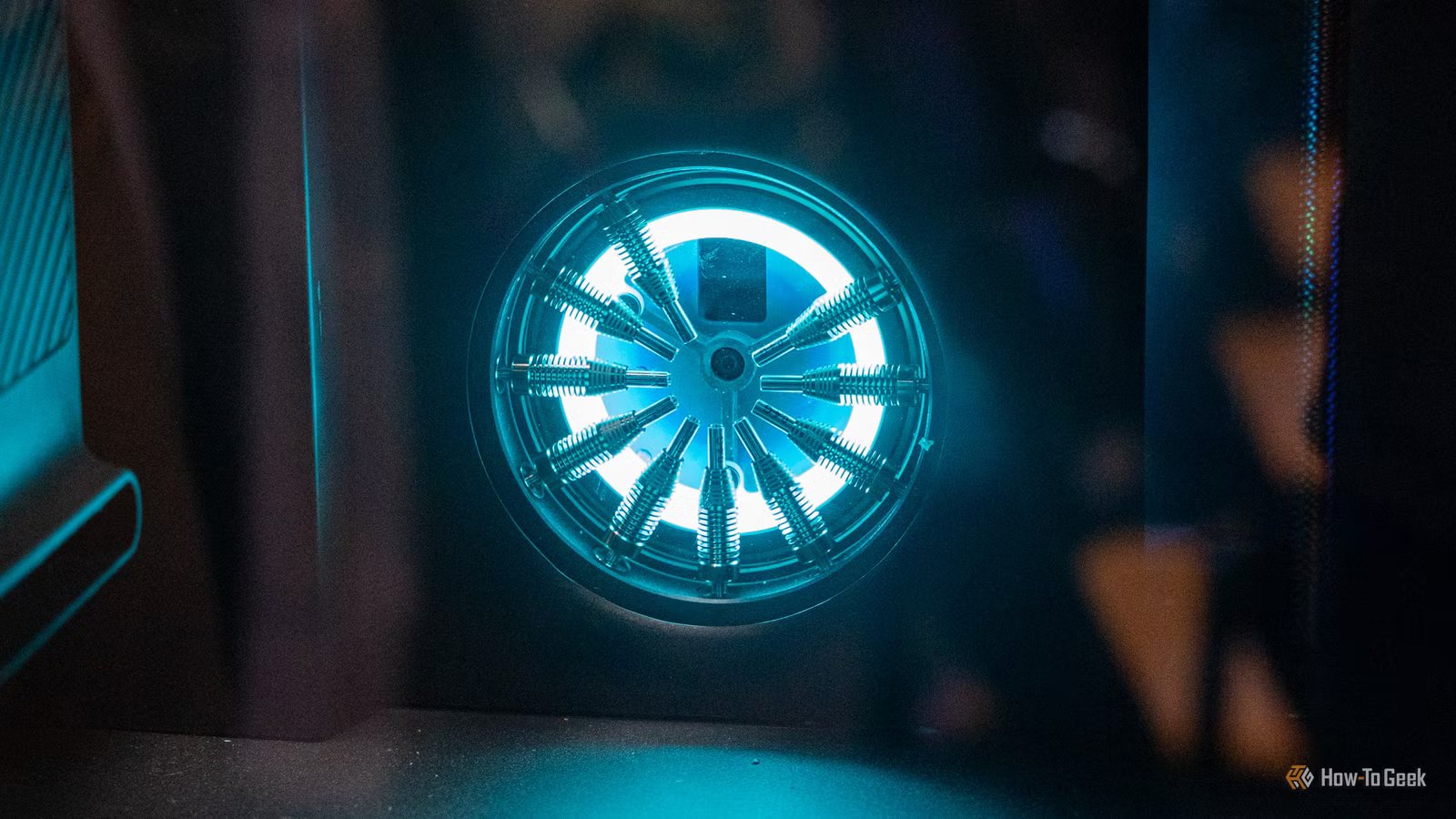
The AtomForm is a pretty special 3D printer. It focuses on making multi-material and multicolor printing easier and more efficient than ever before. Utilizing a 12-nozzle rotating carousel, the AtomForm is able to do material and color changes quickly and efficiently.
I was able to go hands-on with the AtomForm at the launch party back in March, and I really think this could be the future of multicolor and multi-material 3D printing. But, how does it work?
Mova has done more than just add multiple nozzles to the AtomForm to make it efficient. At the top of the printer, there are two filament feed tubes that go toward the print head, whereas normally printers, even multi-nozzle printers, only have one.
These two feed tubes allow for the least amount of downtime between color changes as possible. The printer can have one filament fed through to the toolhead, and another waiting right there, so as soon as the current color is retracted, the new color is fed in.

However, that’s not where the magic is. The magic lies in the 12-nozzle rotating carousel. Whenever a filament change comes up, instead of having to purge the old filament out, it simply cuts the filament and drops that nozzle back into the carousel and grabs the nozzle that corresponds with the new filament color—no waste required.
Seeing this work in person was actually quite awesome. I was very impressed with it, though the early prototypes we were seeing definitely had some bugs and quirks to work out.
Not only does this work for multiple colors, but it also works for different materials and nozzle types. So, you could have PLA in one nozzle, PETG in another, and PA-CF in another, with each nozzle being made of the material that matches the filament going through it.
I was a bit worried about how well the new nozzle would lock in, as well as how it would line up with the head through multiple swaps. Mova has thought of this, though, and has multiple camera angles that verify the position of the nozzle and accuracy of its placement before it starts printing again.
It feels like they’ve thought of everything here, and I’m really excited to get an AtomForm in the office at some point to actually try printing myself with it. Seeing it print in person, though, was really awesome. It definitely created a lot less waste than traditional multicolor 3D printers.
I honestly can’t wait for true no-waste multicolor printing
The excess waste is the main thing keeping me from doing multicolor prints right now
Right now, I avoid multicolor 3D printing as much as possible, even though I would love to use it more frequently. My Bambu Lab P1S and P2S with an AMS is definitely capable of multicolor 3D printing, and I give in it from time to time, but it’s not frequent because of the waste generated.
I just can’t bring myself to use more filament on purges than I’m using in the actual print. Since I’m not doing production 3D printing either, there’s really no chance of me being able to just scale it up so I’m using the same amount of purge for more items, thus making the ratio smaller.
I think Mova’s AtomForm Palette 300 will make multicolor 3D printing something that anyone can do without spending a fortune. The actual printer won’t be all that cheap, but it’ll definitely pay for itself over time with saved filament.
It’s only a matter of time before other brands adopt this strategy
Before Bambu Lab released its X1 Carbon with AMS, multicolor 3D printing wasn’t really a big thing at all. It was definitely possible, but only in more industrial applications or with manual filament swaps. Bambu Lab took multicolor 3D printing mainstream, and now almost every brand has its own form of a color-swapping system.
I feel like Mova’s AtomForm Palette 300 could be the next type of revolution in multicolor and multi-material 3D printing. I think in the next few years we’ll see more and more companies going with a rotary-style nozzle swapping system in their 3D printers, and I’m definitely here for it.