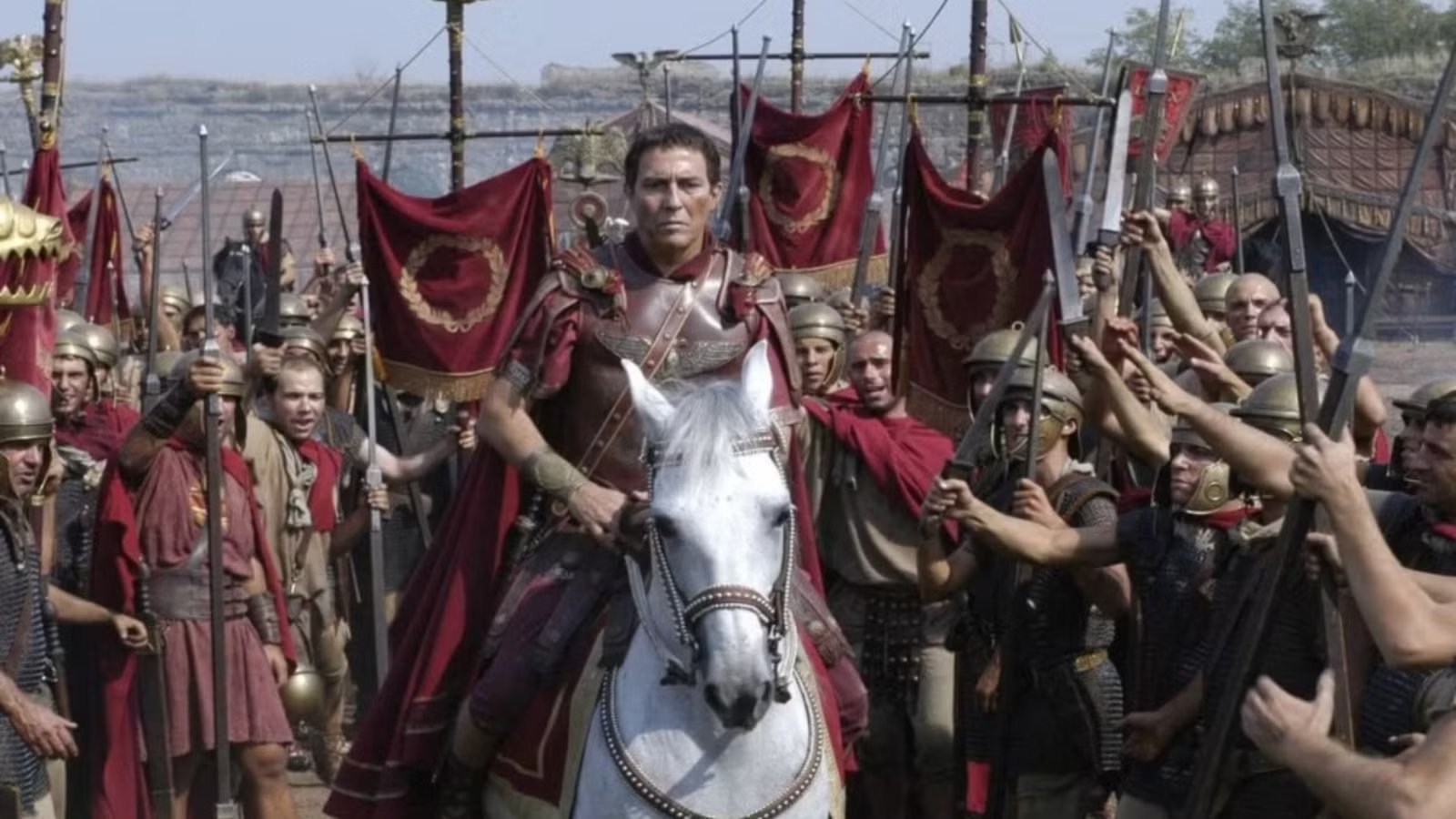
HBO has given us many iconic series over the years, from The Sopranos to The Wire to Sex and the City and beyond. An embarrassing number of HBO shows have become modern classics, but some have largely been forgotten despite being just as good, and maybe even more influential.
Case in point: Rome, a two-season historical epic that aired between 2005 and 2007. This show has sky-high ratings on Rotten Tomatoes, where audiences come close to giving it a near 100% fresh rating with critics not far behind. And yet, it’s been criminally forgotten when people discuss the HBO canon.
Rome makes history come alive
With some caveats
Rome is what it sounds like: a historical drama focusing on ancient Rome. Specifically, the show zeroes in on one of the most famous, tumultuous points in the history of the civilization: the decades leading up to the year 0, when the Roman Republic was supplanted and the Roman Empire began.
In brief, Rome covers the rise of Julius Caesar (Ciarán Hinds) as he takes over Rome and establishes himself as a dictator; his death at the hands of his colleagues, including Brutus (Tobias Menzies); the rise of his great nephew Octavian (Max Pirkis in Season 1 and Simon Woods in Season 2) as the new Caesar; and Mark Antony (Mark Purefoy) making a last stand against Octavian in Egypt alongside Cleopatra (Lyndsey Marshal). If you want to make a TV show about Rome, this is the time period to set in it in.
But Rome doesn’t limit itself to only spending time with famous historical figures; much of the story is told through the eyes of two ordinary soldiers: the straight-laced Lucius Vorenus (Kevin McKidd) and the carousing Titus Pullo (Ray Stevenson). The friendship between these two is at the center of the show, and always gives us some solid ground to return to.
Vorenus and Pullo were actual soldiers, but almost nothing is known about them beyond the fact that they existed, so the writers on Rome make a lot of stuff up. For instance, in real history, Julius Caesar has a son with Cleopatra named Caesarion, who later becomes a threat to Octavian’s rule. In the show, Caesarion is actually the biological son of Titus Pullo, and Cleopatra only passes him off as Caesar’s son to better her political position. Rome gets the broad strokes of history correct, but it has a lot of fun with the details. The goal is to be authentic but not necessarily accurate.
Rome is wonderful while it lasted
Even if it didn’t last long enough
One way Rome sells authenticity is by going the extra mile when it comes to research, sets, and costumes. The ancient world looks lively and bright, with nearly $10 million spent per episode in the first season to make sure every frame is a feast for the eyes. At the time, Rome was the most expensive show ever made, and you could see that money on the screen.
Rome also stays authentic by refusing to dumb down its characters or divide them into “good guys” and “bad guys.” For example, Titus Pullo and Lucius Vorenus both do amoral, evil things over the course of the show, but they also have it in them to be heroic and self-sacrificing. Sometimes, historical fiction shows can apply modern morality to a pre-modern time, but Rome is set in a world where our standards of good and bad don’t necessarily apply, and that to its credit.
Unfortunately, the costly budget eventually caught up to the show. After a BBC co-financing deal fell through, HBO canceled the series after the second season. The creators found out partway through, so they condensed events meant for seasons 3 and 4 into the back half of Season 2, which moves noticeably faster than everything that came before. It makes for brisk watching, but it would have been fun to see some of these events stretched out over multiple seasons. And the creators never got to include anything related to Jesus of Nazareth, whose ascendancy was going to be the focus of a fifth and final season. I’d be very curious to see what Titus Pullo would have made of him.
Long live Rome
In life and on TV
Although Rome doesn’t get the love it deserves today, it lives on the form of the many shows it influences. Most obviously, Game of Thrones started a few years after Rome ended, and obviously takes cues from the show. Game of Thrones may not be about actual history, but it was a faux-historical HBO epic that would eventually eclipse Rome as the most expensive TV series ever made, only Game of Thrones was also a global hit that justified the cost. And it never would have happened had HBO not proven to itself that it could make a show with that kind of scale with Rome.
Game of Thrones even hired several actors from Rome to be part of its cast, including Tobias Menzies, Ciarán Hinds, and Indira Varma, who played Lucius Vorenus’ wife Niobe. Many shows today are still modeling themselves off Game of Thrones, which means that they’re also inheriting the legacy of Rome.

There’s one Lord of the Rings tale left to tell, but Hollywood is too scared
The Lord of the Rings franchise has one chance to feel exciting again.
Further watching
Pretty much any lavish historical fiction drama made in the 2010s owes at least something to Rome, including great watches like Black Sails and The Last Kingdom. As for Rome itself, it’s still available to stream on HBO Max.